Introduction to How the iPhone Works

iPhone Image Gallery

Apple iPhone
Image courtesy Apple
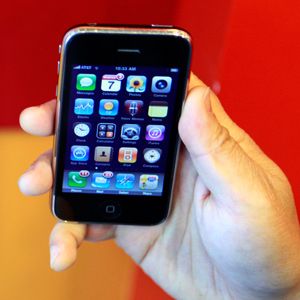
The Apple iPhone.
See more iPhone pictures.

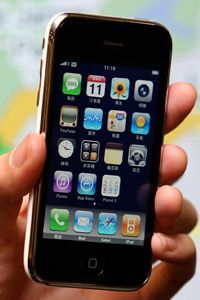
In January 2007, Steve Jobs introduced the Apple iPhone during his keynote address at the Macworld Conference and Expo. In its first appearance onscreen and in Jobs's hand, the phone looked like a sleek but inanimate black rectangle.

Then, Jobs touched the screen. Suddenly, the featureless rectangle became an interactive surface. Jobs placed a fingertip on an on-screen arrow and slid it from left to right. When his finger moved, the arrow moved with it, unlocking the phone. To some people, this interaction between a human finger and an on-screen image -- and its effect on the iPhone's behavior -- was more amazing than all of its other features combined.

And those features are plentiful. In some ways, the iPhone is more like a palmtop computer than a cellular phone. As with many smartphones, you can use it to make and receive calls, watch movies, listen to mu­sic, browse the Web, and send and receive e-mail and text messages. You can also take pictures with a built-in camera, import photos from your computer and organize them all using the iPhone's software.

­In 2008, Apple introduced the second generation iPhone. The new iPhone can operate on third-generation (3G) cellular networks and has a GPS receiver. The iPhone also lets you view map and satellite data from Google Maps, including overlays of nearby businesses. Owners of the original iPhone got the opportunity to upgrade the software on their phones. The 2.0 software gives the old phones new functions, but without the GPS receiver or 3G network capability.

­A modifie­d version of the Macintosh OS X operating system used on Apple desktop and laptop computers lets you interact with all of these applications. It displays icons for each application on the iPhone's screen. It also manages battery power and system security. The operating system synchs the phone with your computer, a process that requires a dock much like the one used to synch an iPod. It also lets you multitask and move through multiple open applications, just like you can on a laptop or desktop computer.­

Learn More

But instead of using a mouse or a physical keyboard, the iPhone uses virtual buttons and controls that appear on its screen. This isn't really a new phenomenon -- touch screens have been part of everything from self-checkout kiosks to smartphones for years. But the iPhone's touch-screen is a little different from many of the others currently on the market. When you touch the screen on a PDA or a Nintendo DS, you typically use a slender, pointed stylus. The iPhone, on the other hand, requires you to use your fingers. It can also detect multiple touch points simultaneously, which many existing touch-screens cannot do.

­This article will explore exactly how the iPhone's touch-screen carries instructions from your fingertips to the phone's internal circuitry. We'll also look at the iPhone's features, its hardware and how it compares to smartphones and other electronic devices.

­

iPhone Touch Screen

Electronic devices can use lots of different methods to detect a person's input on a touch-screen. Most of them use sensors and circuitry to monitor changes in a particular state. Many, including the iPhone, monitor changes in electrical current. Others monitor changes in the reflection of waves. These can be sound waves or beams of near-infrared light. A few systems use transducers to measure changes in vibration caused when your finger hits the screen's surface or cameras to monitor changes in light and shadow.

An array of touch-screen products
Image courtesy Consumer Guide Products
The Nintendo DS, Palm Treo and Logitech Harmony Remote Control
all use touch-screen technology.

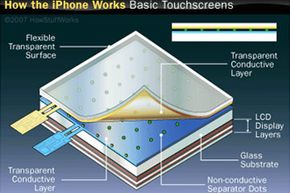
The basic idea is pretty simple -- when you place your finger or a stylus on the screen, it changes the state that the device is monitoring. In screens that rely on sound or light waves, your finger physically blocks or reflects some of the waves. Capacitive touch-screens use a layer of capacitive material to hold an electrical charge; touching the screen changes the amount of charge at a specific point of contact. In resistive screens, the pressure from your finger causes conductive and resistive layers of circuitry to touch each other, changing the circuits' resistance.

Most of the time, these systems are good at detecting the location of exactly one touch. If you try to touch the screen in several places at once, the results can be erratic. Some screens simply disregard all touches after the first one. Others can detect simultaneous touches, but their software can't calculate the location of each one accurately. There are several reasons for this, including:

  • Many systems detect changes along an axis or in a specific direction instead of at each point on the screen.
  • Some screens rely on system-wide averages to determine touch locations.
  • Some systems take measurements by first establishing a baseline. When you touch the screen, you create a new baseline. Adding another touch causes the system to take a measurement using the wrong baseline as a starting point.

Basic touchscreen technology


The Apple iPhone is different -- many of the elements of its multi-touch user interface require you to touch multiple points on the screen simultaneously. For example, you can zoom in to Web pages or pictures by placing your thumb and finger on the screen and spreading them apart. To zoom back out, you can pinch your thumb and finger together. The iPhone's touch screen is able to respond to both touch points and their movements simultaneously. We'll look at exactly how the iPhone does this in the next section.

Back-side Touch-screen?

­According to Apple's patent filings, the company may have considered incorporating a touch-screen on the back of the iPhone rather than the front.


Multi-touch Systems

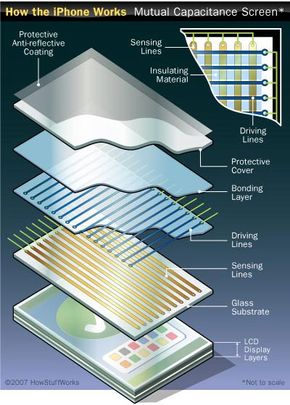
To allow people to use touch commands that require multiple fingers, the iPhone uses a new arrangement of existing technology. Its touch-sensitive screen includes a layer of capacitive material, just like many other touch-screens. However, the iPhone's capacitors are arranged according to a coordinate system. Its circuitry can sense changes at each point along the grid. In other words, every point on the grid generates its own signal when touched and relays that signal to the iPhone's processor. This allows the phone to determine the location and movement of simultaneous touches in multiple locations. Because of its reliance on this capacitive material, the iPhone works only if you touch it with your fingertip -- it won't work if you use a stylus or wear non-conductive gloves.

Mutual capacitance touch-screen

A mutual capacitance touch-screen contains a grid of sensing lines and driving lines to determine where the user is touching.

Self capacitance screen

A self capacitance screen contains sensing circuits
and electrodes to determine
where a user is touching.

The iPhone's screen detects touch through one of two methods: Mutual capacitance or self capacitance. In mutual capacitance, the capacitive circuitry requires two distinct layers of material. One houses driving lines, which carry current, and other houses sensing lines, which detect the current at nodes. Self capacitance uses one layer of individual electrodes connected with capacitance-sensing circuitry.

Both of these possible setups send touch data as electrical impulses. In the next section, we'll take a look at exactly what happens.

iPhone Processor

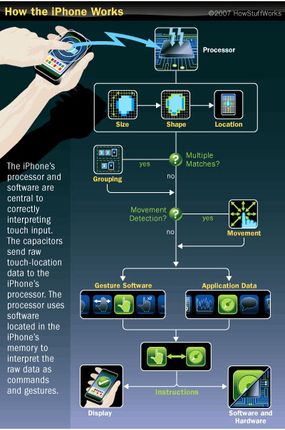
The iPhone's processor and software are central to correctly interpreting input from the touch-screen. The capacitive material sends raw touch-location data to the iPhone's processor. The processor uses software located in the iPhone's memory to interpret the raw data as commands and gestures. Here's what happens:

  1. Signals travel from the touch screen to the processor as electrical impulses.
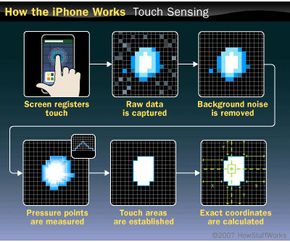
  2. The processor uses software to analyze the data and determine the features of each touch. This includes size, shape and location of the affected area on the screen. If necessary, the processor arranges touches with similar features into groups. If you move your finger, the processor calculates the difference between the starting point and ending point of your touch.

iPhone touch sensing

  1. The processor uses its gesture-interpretation software to determine which gesture you made. It combines your physical movement with information about which application you were using and what the application was doing when you touched the screen.
  2. The processor relays your instructions to the program in use. If necessary, it also sends commands to the iPhone's screen and other hardware. If the raw data doesn't match any applicable gestures or commands, the iPhone disregards it as an extraneous touch.

The iPhone's processor and sensor


All these steps happen in an instant -- you see changes in the screen based on your input almost instantly. This process allows you to access and use all of the iPhone's applications with your fingers. We'll look at these programs and the iPhone's other features in more detail in the next section, as well as how the iPhone's cost measures up to its abilities.

Other Multi-touch Systems

When Apple first announced the iPhone, there weren't many multi-touch systems on the market. New York University had released a dramatic demonstration video of the results of its research into multi-touch interfaces, but few such systems had made it into practical use.

­ In May 2007, however, Microsoft announced Surfac­e multi-touch computer system. Surface uses cameras and light for its multi-touch interface. If you're looking for Surface, you might have to wait; Microsoft is concentrating on commercial markets first, though a consumer version is scheduled for the future.

iPhone Features

The front surface of the Apple iPhone has only one button -- the Home button. Pressing the Home button takes you to the main screen of the iPhone's graphical user interface. There, you can choose from the device's four primary functions using icons at the bottom of the phone:

  • Phone: 3G, GSM or EDGE cellular phone service as well as a visual voice mail menu
  • Mail: POP and IMAP e-mail access, including in-line pictures, HTML capabilities and push e-mail from Yahoo mail
  • Web: Safari Web browser
  • iPod: Music and videos

iPhone
Photo courtesy Apple

You can open the iPhone's other applications from the upper portion of the Home screen. These include a calendar, calculator, notepad, and widgets, or mini-applications made specifically for the iPhone. The iPhone includes a 2.0-megapixel camera and software you can use to organize your pictures. You can also use an iPhone to check weather reports and stock quotes. Even though the iPhone doesn't support Flash, which the YouTube site relies on, you can watch YouTube videos using the corresponding application. The keys and buttons you need to navigate each application appear only when you need them.

The shape of the screen changes when you need it to as well -- you can shift the perspective from vertical to horizontal by tilting the phone. An accelerometer inside the iPhone lets the operating system know to change the orientation of the image on the screen. This means that you can scroll through long lists of music files on a long, narrow screen, and you can watch movies in a widescreen format. You can learn more about accelerometers in How the Nike + iPod Works and How the Wii Works.

iPhone Specs
Apple is fairly secretive about the exact processors and circuitry found in the iPhone. Here's a glimpse of what it takes to keep the device running:
  • 3.5-inch, 163 ppi screen with a glass protective covering
  • Battery with up to 10 hours of talk time on 2G networks, 5 hours on 3G, 6 hours of Internet use on wifi, 5 hours on 3G, 7 hours of video playback, 24 hours of audio playback and 300 hours of standby time [source: Apple]
  • Macintosh OS X operating system
  • Ambient light sensor
  • Accelerometer
  • Radio transmitters for Bluetooth, WiFi and cellular (3G, GSM and EDGE) signals
  • Proximity sensor, which likely produces near-infrared light and measures its reflection from nearby objects
  • 8 GB or 16 GB of storage space

Check out Apple's lists of specs for more.

The second generation of the iPhone introduced several new features. We'll take a closer look at those in the next section.

3G iPhone Applications and Problems

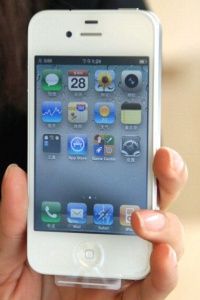
In June 2008, Steve Jobs unveiled the 3G iPhone at a conference for application developers. Apple offers 8 GB and a 16 GB options. The new phone's appearance only changed a little bit -- the new model has a slightly sleeker design and its back isn't silver any more. Customers who buy the 16 GB model can choose between an iPhone with a black or white plastic back. The 8 GB model only comes in black.

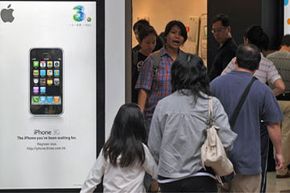
Waiting in line for the 3G iPhone
Andrew Ross/AFP/Getty Images
Customers in Hong Kong wait in line to buy the 3G iPhone.

Perhaps the biggest announcement -- apart from the fact that the phone could take advantage of 3G network technology -- was that the new iPhone has a GPS receiver. One of the challenges of GPS devices is that they tend to drain batteries pretty quickly. That's because the device is constantly receiving signals from satellites orbiting the Earth.

Another important addition to the iPhone was support for Microsoft Exchange. Microsoft Exchange support means users can now synchronize their iPhones with their Microsoft Outlook accounts. By adding this feature, the iPhone becomes more competitive with other enterprise smartphones -- the phones businesses use to keep executives and employees connected when out of the office.

Apples to Apples
Why does Apple call the second generation of iPhones the 3G iPhone? It's because the new iPhone can take advantage of the 3G cellular network. So the phone is in its second generation, but the network is in its third. The United States has a fairly limited 3G network, so U.S. citizens might not be able to tap into the faster speeds even if they buy the 3G iPhone.

When it released the original iPhone, Apple didn't support third-party applications, though that didn't stop developers from writing them. But with the original iPhone, in order to even run a non-Apple application, an iPhone owner had to first jailbreak his or her phone. Jailbreaking just means the owner could load and run third party applications. But it came with a risk -- if you tried to install official updates from Apple with a jailbroken phone, Apple could tell that some hanky panky was going on. But the new 3G iPhone acts as an application platform, and Apple encourages developers to create content for it.

Trouble in the Background
Although Apple now encourages developers to create applications for the iPhone, the company still doesn't let any outside application access background processes. That means you have to run a program actively to take advantage of it. If you switch to a different program, all activity on the first program will stop.

The transfer to the 3G iPhone didn't go without a hitch. Instead of allowing customers to purchase phones and activate them at home, Apple wanted them to activate the phones inside the store. Unfortunately, Apple's systems suffered an overload, causing massive delays during the product launch. Most customers ended up having to activate at home anyway.

Some of the new applications take advantage of the iPhone's accelerometer feature. Games like Super MonkeyBall let the player control the game character by tilting the phone in different ways. Could the iPhone become the next portable gaming platform?

These features sound impressive, but many of them already exist on other smartphones. We'll explore the iPhone's competition and its pros and cons in the next section.

iPhone Prices and Competition

Apple iPhone vs. Cisco iPhone
When Apple announced the iPhone in January 2007, it quickly got the attention of computer technology company Cisco. Cisco was already using the iPhone name on a range of VoIP products and services. Cisco filed a lawsuit, but the two companies eventually reached an agreement with undisclosed terms in February 2007. The agreement allows both companies to use the iPhone name.

The iPhone has gotten a lot of attention in the press, but other phone models already have similar features. Numerous smartphones have a built-in Opera Web browser designed for mobile devices. Although most other phones don't have completely virtual controls, some, like the Helio Ocean, have multiple physical keyboards. You can slide the front portion of the Ocean vertically to access a number pad or horizontally to access a QWERTY keyboard. The orientation of the images on the screen changes depending on which keyboard you are using. Other phones, like the Samsung Instinct, the LG Prada and the HTC Touch phone, use touch-screens and virtual controls much the way the iPhone does.

LG Prada
Image courtesy © 2007 LG Electronics
LG Prada

Some smartphones also have features that an iPhone doesn't. Several iPhone owners have expressed frustration that basic features like cut and paste aren't included in the iPhone. Despite including a GPS receiver in the 3G iPhone, as of this writing there's still no turn-by-turn feature. The iPhone doesn't support multimedia messages (MMS) either, something that many smartphones -- and even basic cell phones -- can do. Finally, the complete absence of a physical keyboard may prove challenging for some users, even though though Apple insists that having no keyboard is part of what makes the iPhone so usable. Apple or third-party developers may address some of these drawbacks in software updates or downloadable applications.

HTC Touch

The HTC Touch
Image courtesy
­© 2007 High Tech Computer Corp.

At its introduction, the iPhone's price was $499 for 4 GB of storage space and $599 for 8 GB. In September 2007, Apple announced that it was lowering the price of the 8 GB model to $399 and that it would continue to sell the 4 GB model while supplies lasted. The 3G iPhone came with another drop in price: The new 8 GB 3G iPhone is available for $199. Apple was able to discount the phone because phone service providers like AT&T subsidized the hardware.

In the United States, the iPhone requires a two-year contract with AT&T, formerly known as Cingular. Unless you hack your iPhone and unlock it, it won't work at all without the AT&T plan.

The first iPhone hit the U.S. market on June 29, 2007. In the days after the release, users and reviewers criticized some of the iPhone's features, including slow browsing speeds and difficulty using the virtual keyboard. Customers reported difficulties with the lengthy activation process and itemized paper billing statements that were hundreds of pages long. Consumer-rights advocates also criticized the cost of the iPhone's battery replacement program. Early iPhone adopters were also angry at the dramatic price increase -- Apple responded by offering a $100 store credit [source: Apple]. In spite of all these difficulties, Apple sold its millionth iPhone in September 2007.

To learn more about the iPhone, iPods, cellular phones and related topics, check out the links on the next page.

­

Lots More Information

Related HowStuffWorks Articles

More Great Links

Sources

  • Anderson, Nate. "What Lurks Below Microsoft's Surface?" 5/30/2007 (6/1/2007) http://arstechnica.com/news.ars/post/ 20070530-what-lurks-below-microsofts-surface-a-qa-with-microsoft.html
  • Apple. "Cisco and Apple Reach Agreement on iPhone Trademark." 2/21/2007 (6/1/2007) http://www.apple.com/pr/library/2007/02/21iphone.html
  • Apple: iPhone (7/29/2008)­
    http://www.apple.com/iphone/
  • Apple: iPhone - High Technology (6/1/2007)
    http://www.apple.com/iphone/technology/specs.html
  • Baig, Edward C. "Apple's new iPhone 3G: Still not perfect, but really close." USA Today. July 10, 2008. Accessed July 29, 2008.
    http://www.usatoday.com/tech/columnist/edwardbaig/2008-07-08-iphone-3g-review_N.htm
  • BBC. "Launch Date for iPhone Revealed." 6/4/2007 (6/4/2007).
    http://news.bbc.co.uk/2/hi/technology/6717865.stm
  • Dudley, Brier. "Leading the Charge on iPhone." The Seattle Times. 5/28/2007 (6/1/2007)
    http://seattletimes.nwsource.com/html/businesstechnology/2003724582_brier28.html
  • Elias, John G. "Back-side Interface for Hand-held Devices." U.S. patent application 2007/0103454. ­
    http://freepatentsonline.com/7166791.pdf
  • Ferranti, Marc. "iPhone activation woes hit early buyers." Network World. July 11, 2008. Accessed July 30, 2008.
    http://www.networkworld.com/news/
    2008/071108-iphone-activation-woes-hit-early.html?hpg1=bn
  • Han, Jeff. "Multi-touch Interaction Research." NYU. 2006 (6/1/2007).
    http://cs.nyu.edu/~jhan/ftirtouch/
  • Hotelling, Steve et al. "Gestures for Touch Sensitive Input Devices." U.S. patent application 2006/0026521.
    http://www.freepatentsonline.com/20060026521.pdf
  • Hotelling, Steve et al. "Mode-based Graphical User Interfaces for Touch Sensitive Input Devices." U.S. patent application 2006/0026535.
    http://www.freepatentsonline.com/20060026535.pdf
  • Hotelling, Steve et al. "Multipoint Touchscreen." U.S. patent application 2006/0097991.
    http://www.freepatentsonline.com/20060097991.pdf
  • Grossman, Lev. "Apple's New Calling: the iPhone." Time. 1/9/2007 (6/1/2007)
    http://www.time.com/time/business/article/0,8599,1575410,00.html
  • Jobs, Steve. Macworld Expo keynote address. 1/9/2007 (6/1/2007)
    http://www.apple.com/quicktime/qtv/mwsf07/
  • Ording, Bas. "Operation of a Computer with a Touch Screen Interface." U.S. patent application 2006/0053387.
    http://www.freepatentsonline.com/20060053387.pdf
  • Robbin, Jeffrey L. et al. "Graphical User Interface and Methods of Use Thereof in a Multimedia Player." U.S. patent 7166791.
    http://freepatentsonline.com/7166791.pdf
  • Simon, Michael. "iPhone: Will it Be the Next Newton?" MacLife. 5/11/2007 (6/1/2007)
    http://www.maclife.com/article/iphone_will_it_be_the_next_newton
  • Zadesky, Stephen Paul et al. "Actuating User Interface for Media Player." U.S. patent application 2006/2050377.
    http://www.freepatentsonline.com/20060250377.pdf