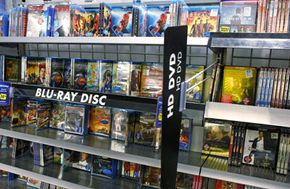
If you used to watch movies on videotape, you probably remember the first time you saw one on DVD. Suddenly, the video and sound were of much better quality. You could also pause without distorting the picture, skip from chapter to chapter and zoom in on the screen. When studios started adding commentary tracks, "extras" and multiple sound options on each disc, it seemed like the technology had reached its peak. People couldn't really imagine a better way to watch a recorded movie than on a DVD.
Then TVs got a whole lot bigger.
Advertisement
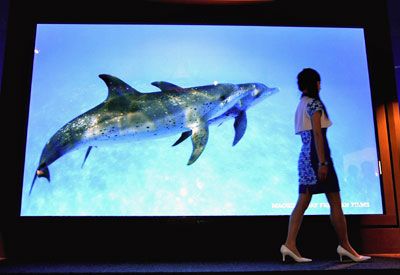
DVDs look best on screens that are smaller than 36 inches (91.4 centimeters), so they're not always up to the challenge of today's high-definition (HD) sets. To store and play HD movies, you need a disc that holds more information, like an HD-DVD. In this article, we'll explore how HD-DVDs differ from DVDs and what happened in the struggle between HD-DVD and Blu-ray.
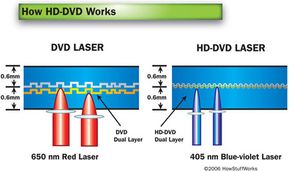
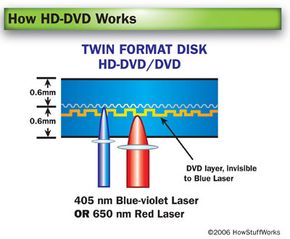
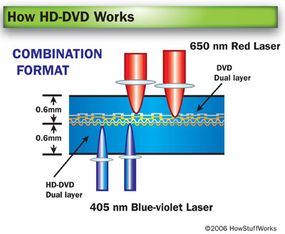
The basic idea behind the HD-DVD is really simple -- it looks like a DVD and acts like a DVD, but it holds more information. A DVD holds about two hours of standard definition video, but an HD-DVD can hold about 4 to 8 hours.
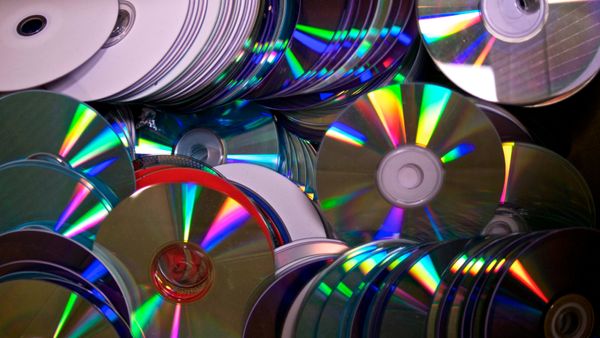
If you already know how DVDs work, then you already know a lot about HD-DVDs. A DVD stores information as a series of microscopic pits arranged in a very long spiral. A red laser reads these pits from the other side, so it sees them as bumps. The bumps reflect the laser's light to a sensor. Electronics within the DVD player read the information from the sensor as a digital signal. Check out How DVDs Work to learn more about how a DVD player does this.
A simplified view of what happens in a DVD player. An HD-DVD player is a lot like this, but it can send the signal digitally rather than converting it to analog.
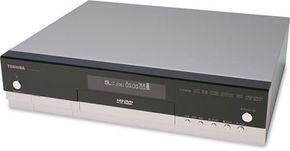
An HD-DVD player is very similar to a DVD player, but it has a few notable differences. We'll look at them in the next section.
Advertisement