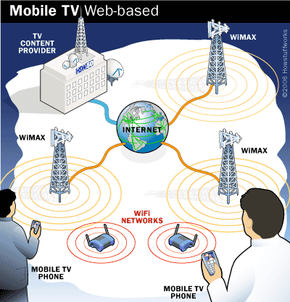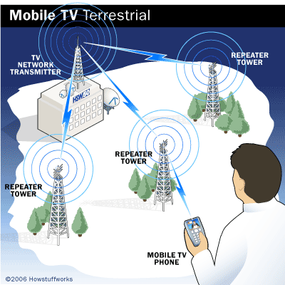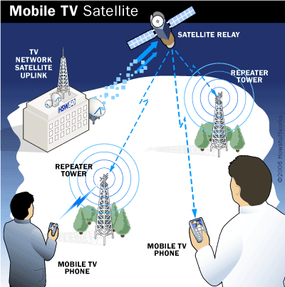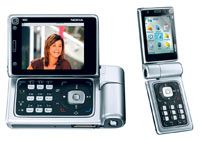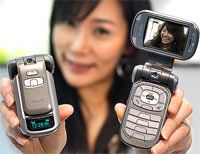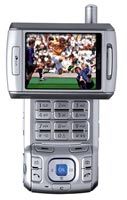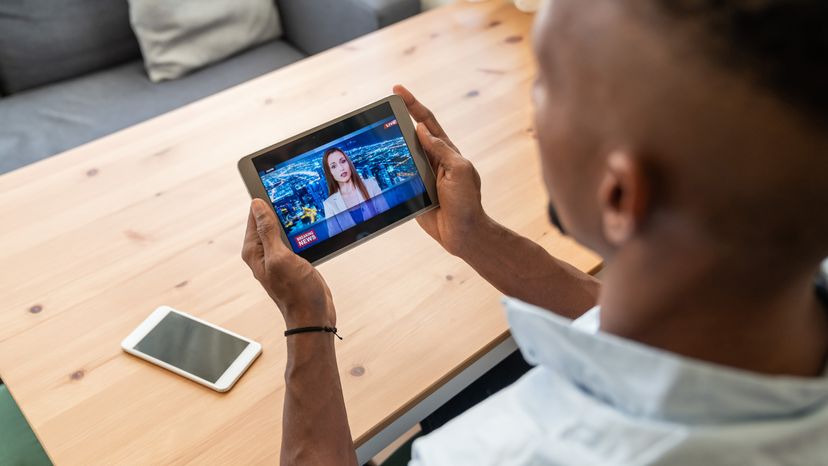
Widespread mobile television has been a long time coming. TV-enabled cell phones have been available in Korea since 2002. In that first incarnation, the TV signals were transmitted over a standard cellular network, meaning per-minute watching fees and unbelievable phone bills. In 2003, Samsung and Vodafone introduced phones in Korea and Japan that received local analog TV broadcasts for free. But the video was choppy, and it drained the phone battery.
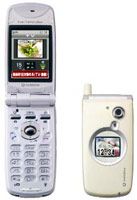
The real "mobile TV revolution" is only beginning, as telecom companies release high-quality, DTV-enabled phones and simultaneously rush to build the broadcast networks to deliver the corresponding content. In this article, we'll find out what types of mobile TV are in the works and take a look at some of the phones that receive the signals.
Advertisement
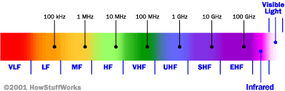
The basic idea of the TV phone is pretty simple: It's a cell phone that acts as a TV receiver. If you've read How Television Works, you know that TV signals are just radio signals. Cell phones pick up radio signals all the time -- it's what they do. In the case of TV phones, they have the ability to receive radio signals in the TV-allocated frequency bands in addition to the bands allocated for cell-phone voice data. For instance, a TV phone in the United States might tune in to the 2110-to-2170-MHz band for a conversation and the 54-to-60-MHz band to pick up TV channel 2.
Just like your home TV, a TV phone has the equipment to extract the audio and video content from radio signals and process them to display a TV show on its screen.
The concept is not earth-shattering, but delivering TV signals within a mobile framework poses some challenges. For one thing, streaming video requires fast transmission speeds. Previous "2G" GSM networks provided data-delivery speeds of 10 to 14 kilobits per second (Kbps), and "2.5G" networks offered 30 to 100 Kbps. At 10 Kbps, a TV show is really a slide show; and at 100 Kbps, it's pretty choppy. There's also the bandwidth issue. Television data takes up a lot more space than voice data, and delivering live TV to thousands of cell phones simultaneously can slow a network to a crawl. Finally, receiving, processing and displaying video content requires battery power, and cell phones don't have much juice to spare.
But technology advances are beginning to make TV phones a viable luxury. Fast "3G" networks (which provide broadband Internet access to cell phones and other mobile devices) provide data-transfer rates of 144 Kbps to 2 megabits per second (Mbps). 3G multicasting technology saves bandwidth by allowing multiple subscribers to access a single broadcast stream (as opposed to unicasting, which is a one-to-one transmission). And companies are implementing power-saving transmission techniques like time slicing, which transmits data in spaced intervals so the receiver can turn off in between transmissions.
While you can subscribe to a TV service plan right now (such as MobiTV, Sprint TV or SmartVideo) if you have the right phone, the standards for mobile TV broadcast and delivery methods are still in their infancy. In the next section, we'll take a look at the primary methods of mobile TV distribution.
TV phones are the way of the future, but click here see how telephones have evolved over time.
Advertisement