For years, the picture on every television set came from a cathode ray tube (CRT). CRTs can make a high-quality picture with great colors, which is why many TVs still use them. Unfortunately, they're also bulky and heavy, and they can't support the big screens that people want today.
Most of the new TV types on the market have improved on CRT's size and weight, but some have a down side when it comes to the picture. Narrow viewing angles, poor black level, burn-in and various visual artifacts can plague newer TVs.
Advertisement
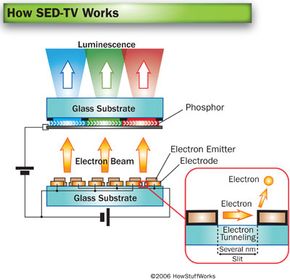
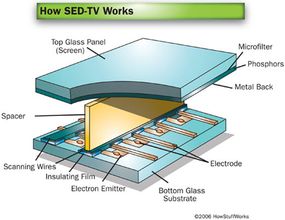
The surface-conduction electron-emitter display (SED) is yet another new TV. But unlike the others, it combines the picture quality of a CRT with the compact design of a flat-screen plasma display. An SED-TV can have a huge screen with a great picture, and it's only a few centimeters thick.
This article will investigate exactly how the SED-TV creates a picture. We'll start with reviewing how CRTs work, and we'll also look at the manufacturing process behind SED-TV's microscopic components.
CRTs: A Review
Some people think of CRTs as old or outdated, especially compared to newer display types like LCD, plasma, DLP and LCoS. But CRT technology is still superior in some ways, and understanding the CRT is central to understanding SED-TV.
Basically, a CRT fires electrons at a phosphorescent screen. When an electron hits the screen, that point, or pixel, glows. The CRT usually uses three streams of electrons, which each strike different phosphors for red, green and blue. Your eye and brain combine the glowing points to create the image you see.
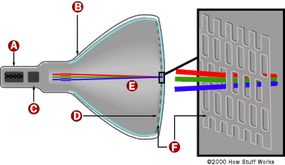

The electrons in the CRT come from a heated filament called a cathode. A cathode is simply a negative electrode, and in a CRT it's similar to a light bulb filament. When electrical current reaches the cathode, electrons stream from it toward the positively-charged anode. The anode accelerates the electrons toward the screen. Electromagnetic steering coils direct the streams of electrons, causing them to paint the image one line at a time, from the top of the screen to the bottom.
Commonly called an electron gun, this collection of cathodes, anodes and electromagnets is the heart of a CRT television. You can learn more about the electron gun and how it creates a picture in How Television Works.
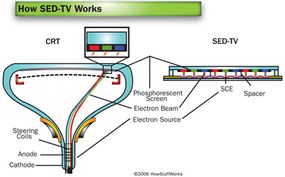
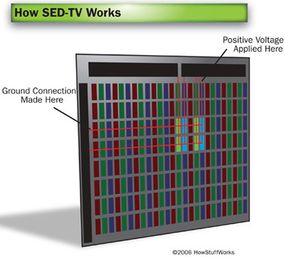
An SED-TV creates a picture in much the same way. It's essentially a flat-panel television that uses millions of CRTs instead of one electron gun. These miniature CRTs are called surface-conducting electron emitters (SCEs). A set has three SCEs for every pixel -- one each for red, green and blue. A widescreen, high-definition set can have more than 6 million SCEs.
Let's take a look at how the SCEs create electrons and the picture.
Advertisement