Introduction to How the Google Phone Works

Justin Sullivan/Getty Images
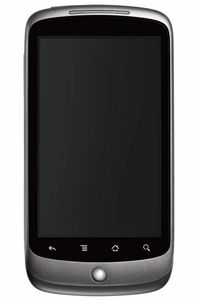
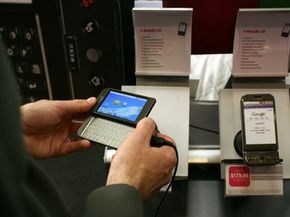
The HTC G1 is the first phone to feature the Google Android OS. See more cell phone pictures
In 2007, people began to circulate rumors that the Google corporation would introduce a smartphone to compete with Apple's iPhone. Speculation ran rampant -- would Google get into the hardware business? Would the company rely on established cell phone manufacturers for hardware? Would Google simply concentrate on building smartphone applications for other devices like the iPhone?
Google executives claimed that the company wasn't interested in building hardware. But some Web journalists and bloggers remained unconvinced. By early 2008, it became clear that the Google executives had been straightforward all along -- Google was not getting into the handset hardware game. But they were getting into the handset software business with a mobile operating system (OS) called Android.
Unlike the Apple iPhone, which has its own OS exclusive to the iPhone's hardware, Google's approach was to create an OS that could work on phones built by different manufacturers. Additionally, no single service provider would have exclusive rights to use the Android platform. In that respect, Android joins other mobile device operating systems like Symbian and Windows Mobile.
The first Google phone was the G1, a handset manufactured by a company based in Taiwan called the High Tech Computer Corporation (HTC). The first service provider to support Android in the United States was T-Mobile. As the OS debuted in the United States, other handset manufacturers announced plans to develop their own Android phones.
|
More Fun Phones
|
An important factor that sets Android apart from most other mobile operating systems is that it's based on an open source platform. That means Google allows anyone to look at and modify most of Android's source code. Ideally, this would mean that if a developer felt Android needed a specific feature or capability, he or she could build it and incorporate it into the OS. The software would constantly evolve.
Initially, the Android platform didn't support many of the features of other smartphone operating systems. For example, Android offered no Microsoft Exchange support upon release. Many companies use Microsoft Exchange as a platform for e-mail and scheduling applications. But because of the open source nature of Android and Google's support for third-party developers, it didn't take long before a company offered an application that would sync Exchange functions with the phone. The Android platform may have to play catch up with the other operating systems on the market, but it may have the ability to go even farther.
On the next page we'll introduce you to the HTC G1, the first phone to feature Google's Android OS.
Google Phone Features
You can divide the features of the HTC G1 (the first phone to run on the Android platform) into two categories: hardware features and Android features. Remember, not every phone running on Android will have the same capabilities as other Android phones. Some of those features are built directly into the hardware and can vary from one manufacturer to the next.
For that very reason, several smartphone reviewers chose to evaluate the Android platform and the HTC G1 hardware separately. For the most part, the reviewers felt the Android platform shows a lot of promise and could become a major player in the smartphone industry. Reviews of the hardware weren't as positive. While most reviewers that the hardware wasn't bad, many said the handset doesn't compare to the sleek form factor of the iPhone.
The HTC G1 sports a 3.2-inch (8.1-centimeter) LCD touchscreen, a GPS transceiver, an accelerometer, an electronic compass, a 3.2 megapixel camera and WiFi and 3G connectivity capability. The screen slides to the side to reveal a full QWERTY keyboard. The handset also has a storage card expansion slot. One thing it doesn't have is a standard headphone jack -- you have to use a USB adapter if you want to use your headphones. Since the phone has a media player, many reviewers felt the lack of a standard jack was strike against the device.
The HTC G1 runs on a 528-megahertz Qualcomm 7201 processor. It also has 192 megabytes of RAM. That makes the HTC G1 a powerful smartphone, though it's not at the top of the heap. Future phones running the Android platform could have completely different specifications.
It's important to note that the Android operating system supports all of these hardware configurations. If Android didn't support a touchscreen interface, the touchscreen wouldn't work even if all the hardware elements were in place. But that doesn't mean every Android phone will have a touchscreen -- it just means Android supports that particular feature.
That being said, some things will remain the same among all Android phones. For example, anyone wanting to buy an Android phone will have to create a Google account first. Google accounts are free and you can sign up at any time whether you own an Android phone or not. If you have a Google account, you can access services like Gmail, Google Calendar and Google Docs. Android's designers built the platform so that it interfaces with these functions smoothly.
As hardware becomes more advanced, Google will tweak the Android OS to support new features and functions. And if Google doesn't do it, someone else will. That's the beauty of an open-source system.
What makes Android tick? Read on to find out.
Google Android Architecture

Justin Sullivan/Getty Images
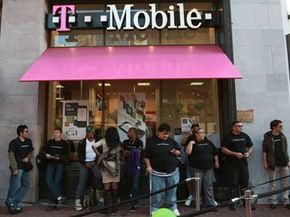
Customers wait in line to purchase a new Google Phone at a T-Mobile store in San Francisco.
Google usually refers to the Android OS as a software stack. Each layer of the stack groups together several programs that support specific operating system functions.
The base of the stack is the kernel. Google used the Linux version 2.6 OS to build Android's kernel, which includes Android's memory management programs, security settings, power management software and several hardware drivers. Drivers are programs that control hardware devices. For example, the HTC G1 has a camera. The Android kernel includes a camera driver, which allows the user to send commands to the camera hardware.
The next level of software includes Android's libraries. You can think of libraries as a set of instructions that tell the device how to handle different kinds of data. For example, the media framework library supports playback and recording of various audio, video and picture formats. Other libraries include a three-dimensional acceleration library (for devices with accelerometers) and a Web browser library.
Located on the same level as the libraries layer, the Android runtime layer includes a set of core Java libraries -- Android application programmers build their apps using the Java programming language. It also includes the Dalvik Virtual Machine.
A virtual machine is a software application that behaves as if it were an independent device with its own operating system. You can run a virtual machine on a computer that operates on a completely different OS than the physical machine's OS. The Android OS uses virtual machines to run each application as its own process. That's important for a few reasons. First, no application is dependent upon another. Second, if an application crashes, it shouldn't affect any other applications running on the device. Third, it simplifies memory management.
The next layer is the application framework. This includes the programs that manage the phone's basic functions like resource allocation, telephone applications, switching between processes or programs and keeping track of the phone's physical location. Application developers have full access to Android's application framework. This allows them to take advantage of Android's processing capabilities and support features when building an Android application. Think of the application framework as a set of basic tools with which a developer can build much more complex tools.
At the top of the stack are the applications themselves. This is where you find the basic functions of the device such as making phone calls, accessing the Web browser and accessing your contacts list. If you're an average user, this is the layer you'll use most. You do that with the user interface. Only Google programmers, application developers and hardware manufacturers access the other layers further down the stack.
You can change the way your Google Phone works by downloading applications to it. Read about a few of them on the next page.
Google Phone Applications

Josep Lago/AFP/Getty Images
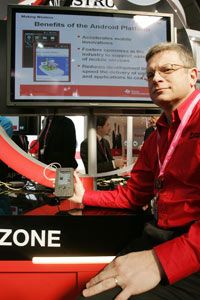
Google showed off an early build of the Android Operating System at several conferences in 2008.
These days, it's not enough for your smartphone to be able to check e-mail and surf the Web as well as make phone calls. You need to have at your disposal a host of useful, fun, productive or just plain pointless applications. The iPhone's success has proven that a strong application library can excite customers. Google's Android platform appears to be following suit.
Months before the HTC G1 hit the shelves, Google unveiled the Android platform to developers. The company created a limited software developer kit (SDK) and distributed it to developers. Google even laid down the Android Developer Challenge -- an contest that had a collective prize pool of $10 million.
The top developers earned $275,000 for their applications. Here's a small sample of what made the grade:
- CompareEverywhere and GoCart are two different applications that let you compare prices and read reviews for merchandise while you're in the store. You take a picture of the item's bar code with the phone's camera. These applications identify the item and aggregate reviews and prices from different sources.
- The Life360 application is part social networking, part news service. It lets you set up a neighborhood-centric online community and share information with other people in that group. It can alert you of emergencies like a tornado warning that affects your neighborhood. Even if you are miles away, you can keep up with what's going on back at home.
- Locale is an application that taps into Android's GPS support. First, you identify various locations you frequent using Google Maps. Then, you create a list of phone settings for each location. For example, at work or in class you'd probably want your phone's ring tone to be appropriate and at a low volume. Once you create the settings for each location, your phone automatically switches to the proper setting based on your current location. Using Locale, you never have to worry about silencing your phone when you walk into your favorite movie theater!
- For the green-conscious, there's Ecorio. This application tracks your global carbon footprint and offers suggestions to reduce your personal impact on the environment. You can use the Google Maps application to plot out a trip and Ecorio offers suggestions for car pooling, public transportation and other tips to create the smallest ecological impact.
- The developers of the Softrace application wanted to build a program that inspires people to maintain an active lifestyle. Softrace lets people set up footraces, bicycle races and other competitions using the Google Maps function. Participants can travel to a race destination, begin the race and try to make the best time. They can compare their results with those of other participants.
There are many more Android applications in the $275,000 winners' circle and beyond. And several developers for some of the better-known iPhone applications have expressed interest in developing an Android version of their apps. While the iPhone has a head start, Android has the potential to equal and perhaps even surpass it on the application front.
So how do these developers build applications for the Android? We'll learn more about the application development process in the next section.
Building Android Applications

Lluis Gene/AFP/Getty Images
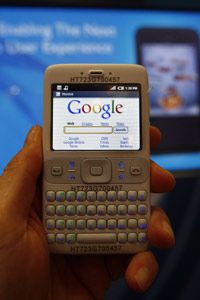
One of the smartphones Google used to demonstrate an early version of Android.
To build an Android application, a developer has to be familiar with the Java programming language. Assuming the developer is proficient in Java, he or she can download the software developer kit (SDK) and get started. The SDK gives the developer access to Android's application programming interface (API).
The SDK includes several tools, including sample applications and a phone emulator. Emulators are programs that duplicate the features and functions of a specific system or device. The Android emulator is a program that duplicates the functions of a phone running on the Android platform. When the developer finishes building an application, he or she can test it out on the emulator to see how the app will perform on actual hardware.
Google provides an extensive Android tutorial on its developer Web site. The company even provides tips on basic programming steps like testing and debugging software. Experienced developers can skip over the tutorial and go straight to building an application. Google even provides step-by-step instructions on how to build an application named Hello World to give developers the chance to become familiar with Android's architecture.
This brings us to another feature of Android that sets it apart from the iPhone -- developers can create complex applications that run in the background of other applications. Apple limits iPhone applications to the foreground -- if you switch to a different application, the first application you were in stops working until you return to it. This feature limits the types of applications developers can build for the iPhone. Android allows developers more extensive access to background processes.
Google breaks down all applications into four basic building blocks (not all applications will have every building block):
- Activities: Whenever an application displays a screen to the user, that's an activity. For example, a map application could have a basic map screen, a trip planner screen and a route overlay screen. That's three activities.
- Intents: Intents are the mechanisms for moving from one activity to another. If you were to plot a trip using our example of the mapping application, an intent would interpret your input and activate the route overlay screen. Android also allows for broadcast intent receivers, which are intents triggered by external events like moving to a new location or an incoming phone call.
- Services: A service is a program that runs on its own without a user interface. For example, let's say you are participating in a Softrace event. Midway through the race, you decide you want to listen to music as you burn up the track. You can switch over to a media player application and start a song while Softrace continues to track your progress. If Softrace were simply an activity, you would have ended the application as soon as you switched to the media player.
- Content provider: A content provider allows an application to share information with other applications. This allows developers to work together to create a suite of applications that are more robust and complex than each individual component.
There are other considerations developers must keep in mind while building applications. They include Android's graphics rendering engine, process management software, user interface support and other technical details. Google provides guides for all of these elements on its Android developer Web site.
The journey of the Google Phone has not always been a smooth one. Some vendors have been quick to accept the OS, while others have dismissed it. Let's take a look at who is and who isn't thrilled about Android.
Google Mobile Phone Vendors

Justin Sullivan/Getty Images
The first Google phone retailed for $179 with a 2-year T-mobile contract.
There are two kinds of vendors you have to consider when you talk about a smartphone operating system: the handset manufacturers and the cell phone service providers. Handset manufacturers produce the actual hardware. Service providers are the phone companies like T-Mobile or AT&T. Some handset manufacturers work exclusively with a specific cell phone provider. In a few cases, a cell phone service provider will also produce its own hardware.
As we mentioned earlier, the first handset to feature the Android OS was the High Tech Computer Corporation's HTC G1. Before the phone even went on sale, bloggers and journalists began to speculate on who would be the next handset manufacturer to get into the Android game. One manufacturer that may soon offer its own Android phone is Motorola. In fact, according to The Wall Street Journal, Motorola may cut back on the operating systems it currently supports to focus on producing Android phones.
Another phone company interested in producing Android phones is Japan's NTT DoCoMo Inc. While that name may not be familiar to U.S. customers, DoCoMo is Japan's largest mobile phone provider. DoCoMo will partner with the South Korean company KTF to produce the handset [source: Reuters]. Other handset manufacturers include Lenovo, Hop-on and Huawei. As the Android OS evolves, we may see more handset manufacturers support the platform with hardware.
The first cell phone provider to support an Android phone was T-Mobile. The company first offered the HTC G1 on its 3G network to customers in the United States in October 2008 for $179 with a contract. A month earlier, T-Mobile offered current customers the opportunity to reserve an HTC G1 in advance. The pre-sale was a huge success -- T-Mobile had to end the sale early when orders exceeded the company's stock of 1.5 million phones [source: Bylund]. We may see more providers support Android in 2009 and beyond.
But some cell phone service providers have gone so far as to criticize the Android OS in public. Sprint CEO Dan Hesse said that Android wasn't "good enough to put the Sprint brand on it" [source: Carew]. Hesse did leave open the possibility that Sprint would work with the Android platform in the future. Meanwhile, Peter Michaels, the CEO of Hop-on, criticized Hesse's statements. Michaels alleged that Sprint makes it hard for inexpensive handset vendors to join their network. He also pointed out that Sprint was a founding member of the Open Handset Alliance -- a project that spawned Android. But Michaels said that while the company says it supports open platforms, its actions seem to contradict those claims [source: MarketWatch].
Other cell phone service providers may take a "wait and see" approach to Android. In the United States, providers like Verizon and AT&T support phones that are in the same competitive space as the HTC G1 (the Blackberry line and the iPhone, respectively). These companies have complicated business and political considerations to take into account before they can support a new operating system. That doesn't mean the obstacles they face are insurmountable -- Verizon announced on Oct. 6, 2009 that the company will support and sell Android-based devices on its network.
Verizon is the largest cell phone carrier in the United States. The company's support of Android could help the OS get a strong foothold in the marketplace. If that happens, Google might dominate the cell phone world the same way it has laid claim to online search.
To learn more about the Google Phone and related topics, dial up the links on the next page.
Lots More Information
Related HowStuffWorks Articles
- 5 Emerging Phone Technologies
- Cell Phone Quiz
- How Cell Phones Work
- How Gmail Works
- How Google Earth Works
- How Google Works
- How Google Docs Works
- How the Googleplex Works
- How Google Talk Works
- How Operating Systems Work
- How Radio Works
- How Smartphones Work
- How the Apple iPhone Works
- How Wifi Works
More Great Links
Sources
- Android. Google. 2008. (Nov. 17, 2008)
http://code.google.com/android/ - Boulton, Clint. "Cemaphore Lets Microsoft Exchange Content Run on Google's Android." Google Watch. Nov. 17, 2008. (Nov. 19, 2008)
http://googlewatch.eweek.com/content/hello_android/cemaphore_lets_
microsoft_exchange_content_run_on_googles_android.html - Bylund, Anders. "Google: We're Fresh Out of Androids." The Motley Fool. Oct. 9, 2008. (Nov. 20, 2008)
http://www.fool.com/investing/high-growth/2008/10/09/google-were-fresh-out-of-androids.aspx - Carew, Sinead. "Sprint: Android not good enough yet." Reuters. Oct. 24, 2008. (Nov. 19, 2008)
http://blogs.reuters.com/mediafile/2008/10/24/sprint-android-not-good-enough-yet/ - Dean, Sam. "Android Hits (Normal) Hiccups As it Matures." Ostatic. Oct. 28, 2008. (Nov. 18, 2008)
http://ostatic.com/175930-blog/android-hits-normal-hiccups-as-it-matures - Gardner, W. David. "Motorola Reportedly Trimming Operating Systems in Favor Of Android." InformationWeek. Oct. 29, 2008. (Nov. 20, 2008)
http://www.informationweek.com/news/mobility/smart_phones/showArticle.jhtml?articleID=211800105 - HTC. "T-Mobile G1." (Nov. 20, 2008)
http://www.htc.com/www/product/g1/overview.html - Live Crunch. "HTC Dream G1 Specs and Review." Aug. 27, 2008. (Nov. 20, 2008)
http://www.livecrunch.com/2008/08/27/htc-dream-g1-specs-and-review/ - Market Watch. "Hop-on Questions Sprint's Spin on Google Android OS." Nov. 4, 2008. (Nov. 20, 2008)
http://www.marketwatch.com/news/story/Hop-Questions-Sprints-Spin-Google/story.aspx?guid={964CBE98-EF5C-46E9-81FD-F4E837FE5371} - Morrison, Diane See. "Japanese Carrier NTT DoMoCo Developing Android-Based Phone." mocoNews. Nov. 19, 2008. (Nov. 20, 2008)
http://www.moconews.net/entry/419-japanese-carrier-ntt-docomo-developing-android-based-phone/ - Nishitani, Yumiko and Izumi, Sachi. "DoCoMo, KTF to sell Google phone next year: report." Reuters. Nov. 19, 2008. (Nov. 20, 2008)
http://www.reuters.com/article/technologyNews/idUSTRE4AI00120081119 - Phones Review. "Huawei Android and Symbian powered smartphones coming next year." Nov. 10, 2008. (Nov. 20, 2008)
http://www.phonesreview.co.uk/2008/11/10/huawei-android-and-symbian-powered-smartphones-coming-next-year/ - Silver, Sara. "Motorola Speed Dials Cell Overhaul." The Wall Street Journal. Oct. 29, 2008. (Nov. 19, 2008)
http://online.wsj.com/article/SB122523624204277979.html