
GSM and CDMA
TDMA is also used as the access technology for Global System for Mobile Communications (GSM). However, GSM implements TDMA in a somewhat different and incompatible way from IS-136. Think of GSM and IS-136 as two different operating systems that work on the same processor, like Windows and Linux both working on an Intel Pentium III. GSM systems use encryption to make phone calls more secure. GSM operates in the 900-MHz and 1800-MHz bands in Europe and Asia and in the 850-MHz and 1900-MHz (sometimes referred to as 1.9-GHz) band in the United States. It is used in digital cellular and PCS-based systems. GSM is also the basis for Integrated Digital Enhanced Network (IDEN), a popular system introduced by Motorola and used by Nextel. AT&T and T-Mobile use GSM.
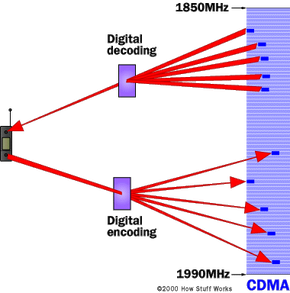
CDMA takes an entirely different approach from TDMA. CDMA, after digitizing data, spreads it out over the entire available bandwidth. Multiple calls are overlaid on each other on the channel, with each assigned a unique sequence code. CDMA is a form of spread spectrum, which simply means that data is sent in small pieces over a number of the discrete frequencies available for use at any time in the specified range. Verizon, Sprint and most other U.S. carriers use CDMA, which means no SIM card.
Advertisement
All of the users transmit in the same wide-band chunk of spectrum. Each user's signal is spread over the entire bandwidth by a unique spreading code. At the receiver, that same unique code is used to recover the signal. Because CDMA systems need to put an accurate time-stamp on each piece of a signal, it references the GPS system for this information. Between eight and 10 separate calls can be carried in the same channel space as one analog AMPS call. CDMA technology is the basis for Interim Standard 95 (IS-95) and operates in both the 800-MHz and 1900-MHz frequency bands.
Ideally, TDMA and CDMA are transparent to each other. In practice, high-power CDMA signals raise the noise floor for TDMA receivers, and high-power TDMA signals can cause overloading and jamming of CDMA receivers.
2G is a cell phone network protocol. Click here to learn about network protocols for smartphones.
Next, we'll look at 3G.