Netflix Recommendations

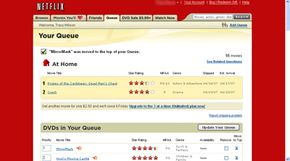
One of the reasons why so many Netflix rentals are older movies rather than new releases is that the site automatically recommends films based on customers' viewing habits. Such recommendation programs are known as collaborative filtering systems. According to Netflix, 60 percent of subscribers add these suggested movies to their queues [Source: Netflix Consumer Press Kit]. These recommendations come from the entire Netflix library, not just the new releases or the mainstream films. In other words, Netflix uses its recommendation system to keep more of its library in circulation more of the time.

Netflix's recommended movies
Netflix's suggestions, or "Movies You'll Love,"
are based on your viewing habits

The Netflix Web site makes these recommendations automatically using a system called CineMatch. CineMatch is a database that uses information from three sources to determine which movies customers are likely to enjoy:

  • The films themselves, which are arranged as groups of common movies
  • The customers' ratings, rented movies and current queue
  • The combined ratings of all Netflix users

The CineMatch database updates itself constantly and makes thousands of recommendations every second, or close to a billion total predictions every day. It all starts after you open your Netflix account and visit the "Movies You'll Love" section on the site. First, you enter your genre preferences into the database. Then, you rate a selection of movies with one to five stars. If you hated a movie, you give it one star, but if you loved it, you give it five. The more movies you rate, the more accurate your recommendations become. On average, Netflix members have about 200 rated movies in their profiles, and the system matches these to 1.7 billion total ratings [Source: Netflix Consumer Press Kit].

Getting good recommendations starts with creating a baseline by rating several movies.
Getting good recommendations starts
with creating a baseline by rating several movies.

Making a good movie recommendation may seem like something that would require instinct or emotion. For example, if you recommend a movie you've seen to a friend, you take into account how the movie made you feel, your tastes and your friend's tastes. CineMatch, on the other hand, is all math. It matches your viewing and rating history with people who have similar histories. It uses those similar profiles to predict which movies you are likely to enjoy. That's what these recommendations really are - predictions of which movies you will like. According to Netflix, these predictions are accurate within half a star 75 percent of the time, and half of Netflix users who rent recommended movies give them a five-star rating [Source: Netflix Investor Press Kit].

These predictions rely on algorithms and statistics. It starts by matching movies to each other rather than matching people to movies, since there are far fewer titles in the library than there are Netflix subscribers. To make matches, a computer:

  1. Searches the CineMatch database for people who have rated the same movie - for example, "The Return of the Jedi"
  2. Determines which of those people have also rated a second movie, such as "The Matrix"
  3. Calculates the statistical likelihood that people who liked "Return of the Jedi" will also like "The Matrix"
  4. Continues this process to establish a pattern of correlations between subscribers' ratings of many different films

The CineMatch system can then compare these patterns to your ratings. It uses a statistical process called a multivariate regression to determine which other movies you will probably like. The database updates itself with new ratings and correlations, or conditions its data, constantly. In a way, the system learns how people watch movies.

Often, these predictions make logical sense. A Netflix customer who gives two movies in the "Lord of the Rings" trilogy five stars is likely to enjoy the third film as well. However, Netflix users who spend a lot of time rating their movies and looking at their recommendations may find some surprising correlations. This is because the algorithms that keep the CineMatch system running don't necessarily have anything to do with the plot or cast. Instead, they have to do with other subscribers' rental and ratings histories.

CineMatch system matches
According to the CineMatch system, subscribers who enjoy both Eddie Izzard's stand-up comedy routines and "Welcome to the Dollhouse," a movie about the unpleasantness of junior high school, will also enjoy the documentary "Life in the Undergrowth."

According to one article in the "New York Times," this recommendation system has significantly changed people's movie preferences. It has given independent releases and films that did not succeed at the box office a wider distribution [Source: New York Times]. As more Netflix subscribers see and rate these lesser-known films, the CineMatch system recommends them to more people.

Regardless of whether someone is renting a classic movie, an independent film or a new release, the Netflix distribution system handles it in the same way. We'll look at how movies get to your home and back to Netflix in the next section.

The Netflix Prize

The CineMatch system's 75 percent accuracy rate seems to be fairly respectable, especially since it involves something as hard to quantify as whether people like a movie. However, Netflix wants to improve the system. The company has established a 5-year contest called the Netflix Prize. It has released 100 million ratings collected over a 7-year period and invited people to use them to find a more accurate algorithm. The goal is to improve the system's accuracy by 10 percent, and the prize is $1 million.