
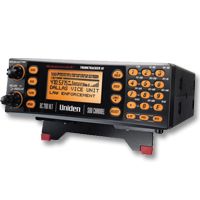
The air around you is bursting with radio waves. You know that you can flip on the AM/FM radio in your car and receive dozens of stations. You can flip on a CB radio and receive 40 more. You can flip on a TV and receive numerous broadcast channels. Cell phones can send and receive hundreds of frequencies. And this is just the tip of the radio spectrum iceberg. Literally tens of thousands of other radio broadcasts and conversations are zipping past you as you read this article -- police officers, firefighters, ambulance drivers, paramedics, sanitation workers, space shuttle astronauts, race car drivers, and even babies with their monitors are transmitting radio waves all around you at this very moment!
To tap into this ocean of electromagnetic dialogue and hear what all of these people are talking about, all you need is a scanner. A scanner is basically a radio receiver capable of receiving multiple signals. Generally, scanners pick up signals in the VHF to UHF range (see How the Radio Spectrum Works for details on these frequency bands).
Advertisement
Radio scanners are very portable and affordable. In this article, we will look at the basics of scanner operation, examine radio scanning as a hobby, and show you how to get started listening to public airwaves you may not have known existed!
Scanner Basics
Scanners typically operate in three modes:
- Scan
- Manual scan
- Search
In scan mode, the receiver constantly changes frequencies in a set order looking for a frequency that has someone transmitting. Lights or panel-mounted displays show what channel or frequency is in use as the scanner stops on a given frequency. The frequencies can be preprogrammed on some models or manually set on practically all models.
In manual scan mode, the user taps a button or turns a dial to manually step through preprogrammed frequencies one frequency at a time.
In search mode, the receiver is set to search between two sets of frequencies within a given band. This mode is useful when a user does not know a frequency, but wants to know what frequencies are active in a given area. If the frequency the scanner stops at during a search is interesting, the user can store that frequency in the radio scanner and use it in scan mode.
Advertisement