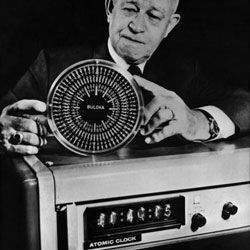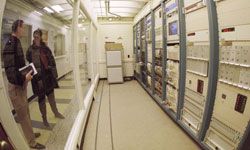
The term "atomic clock" may conjure up scary, 1950s-horror movie mental images: A Doomsday device, constructed by a lab coat-wearing maniac in a mountain fortress, is ticking away the seconds before it wipes out our entire planet. In reality, though, atomic clocks are one of the more benign inventions to emerge from the explosion -- oops, maybe not the best word choice -- of knowledge about the workings of the atom and its parts. That knowledge came in the wake of the World War II Manhattan Project to develop the atomic bomb.
Unlike the bomb, though, atomic clocks don't split atoms and they don't blow up. Instead, they use oscillation -- that is, the change in the flow of electrical charge -- in between an atom's nucleus and its surrounding electrons, the same way an old-fashioned grandfather clock might use a pendulum. Because an atom's oscillation involves incredibly small units of time -- a cesium atom, for example, has a frequency of 9,192,631,770 cycles per second -- and is extraordinarily consistent, a clock set to that oscillation can keep time much better time than that old grandfather clock [source: Britannica].
Advertisement
That's why, since their invention in the late 1940s, atomic clocks have become a critical tool in a modern world dependent on technology. Atomic clocks make it possible to synchronize time across complex systems, ranging from the Internet to the system of Global Positioning Satellites.
But for something that's become such a normal and helpful part of our lives, atomic clocks still remain a bit arcane and mysterious. Here are some of the myriad strange and surprising facts about these helpful devices.