
What's Wrong with Analog TV?
If you currently have an analog TV, and it works fine with broadcast TV, cable TV, VCRs, satellite TV, camcorders and so on, an obvious question would be, "What's wrong with analog TV?"
The main problem is resolution.
Advertisement
- The resolution of the TV controls the crispness and detail in the picture you see.
- The resolution is determined by the number of pixels on the screen.
- An analog TV set can display 525 horizontal lines of resolution every 30th of a second. In reality, however, an analog TV displays half of those lines in a 60th of a second, and then displays the other half in the next 60th, so the whole frame is updated every 30th of a second. This process is called interlacing.
That's been the way TV works for years. But now we've used to looking at computer monitors and expect much better resolution. The lowest-resolution computer monitor displays 640 x 480 pixels. Because of the interlacing, the effective resolution of a TV screen is perhaps 512 x 400 pixels.
So the worst computer monitors you can buy have more resolution than the best analog TV set; and the best computer monitors are able to display up to 10 times more pixels than that TV set. There is simply no comparison between a computer monitor and an analog TV in terms of detail, crispness, image stability and color. If you look at a computer monitor all day at work, and then go home and look at a TV set, the TV set can look very fuzzy.
The drive toward digital TV is fueled by the desire to give TV the same crispness and detail as a computer screen. If you have ever looked at a true digital TV signal displayed on a good digital TV set, you can certainly understand why -- the digital version of TV looks fantastic! There's no comparison. With 10 times more pixels on the screen, all displayed with digital precision, the picture is incredibly detailed and stable.
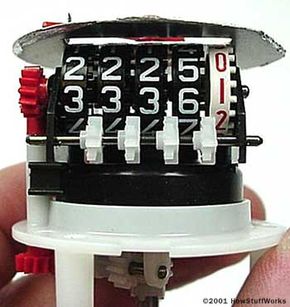
It's hard to convey the difference between a DTV signal and an analog signal without an actual demonstration, but here's a static comparison that can help you understand the idea. Below is a picture of an odometer:
This is a nice, crisp picture. Let's assume that this picture is being displayed on a good digital TV so that this is what you actually see. The following photo shows you what you would see on an analog TV:
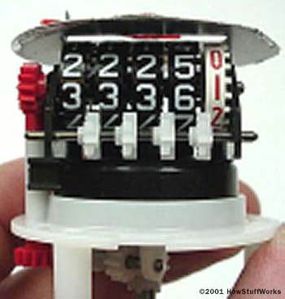
You can see that the analog TV picture is much fuzzier than the digital TV image. Look, for example, at the teeth on the gears. There's a significant difference in picture quality that's even more obvious when the image is moving. It is that quantitative difference that drives the interest in digital TV. And as if the incredible picture weren't enough, digital TV also offers much better sound.