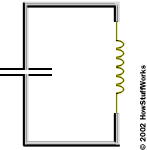
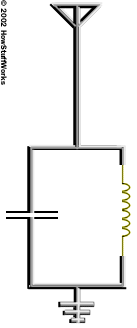
The core principle behind oscillator operation is positive feedback combined with an amplification process. Positive feedback refers to the process where a portion of the output signal is fed back into the system's input in a way that reinforces the initial signal.
For an oscillator to start and maintain its operation, the total loop gain of the system — the product of the amplifier gain and the feedback loop's gain — must be equal to or greater than one. Additionally, the phase shift around the loop must sum to a multiple of 360 degrees to ensure the signal reinforces itself with each cycle, leading to sustained oscillation.
The Pendulum Example
One of the most commonly used oscillators is the pendulum of a clock. If you push on a pendulum to start it swinging, it will oscillate at a desired frequency — it will swing back and forth a certain number of times per second. The length of the pendulum is the main thing that controls the frequency.
For something to oscillate, energy needs to move back and forth between two forms. For example, in a pendulum, energy moves between potential energy and kinetic energy. When the pendulum is at one end of its travel, its energy is all potential energy and it is ready to fall. When the pendulum is in the middle of its cycle, all of its potential energy turns into kinetic energy and the pendulum is moving as fast as it can. As the pendulum moves toward the other end of its swing, all the kinetic energy turns back into potential energy. This movement of energy between the two forms is what causes the oscillation.
Eventually, any physical oscillator stops moving because of friction. To keep it going, you have to add a little bit of energy on each cycle. In a pendulum clock, the energy that keeps the pendulum moving comes from the spring. The pendulum gets a little push on each stroke to make up for the energy it loses to friction. An electronic oscillator works on the same principle.