
Capturing Color
Unfortunately, each photosite is colorblind. It only keeps track of the total intensity of the light that strikes its surface. In order to get a full color image, most sensors use filtering to look at the light in its three primary colors. Once the camera records all three colors, it combines them to create the full spectrum.
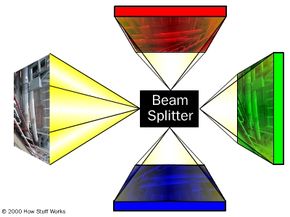
There are several ways of recording the three colors in a digital camera. The highest quality cameras use three separate sensors, each with a different filter. A beam splitter directs light to the different sensors. Think of the light entering the camera as water flowing through a pipe. Using a beam splitter would be like dividing an identical amount of water into three different pipes. Each sensor gets an identical look at the image; but because of the filters, each sensor only responds to one of the primary colors.
Advertisement
The advantage of this method is that the camera records each of the three colors at each pixel location. Unfortunately, cameras that use this method tend to be bulky and expensive.
Another method is to rotate a series of red, blue and green filters in front of a single sensor. The sensor records three separate images in rapid succession. This method also provides information on all three colors at each pixel location; but since the three images aren't taken at precisely the same moment, both the camera and the target of the photo must remain stationary for all three readings. This isn't practical for candid photography or handheld cameras.
Both of these methods work well for professional studio cameras, but they're not necessarily practical for casual snapshots. Next, we'll look at filtering methods that are more suited to small, efficient cameras.