Why Do Data Centers Need Water? Especially Billions of Gallons?
Dec 31, 2025
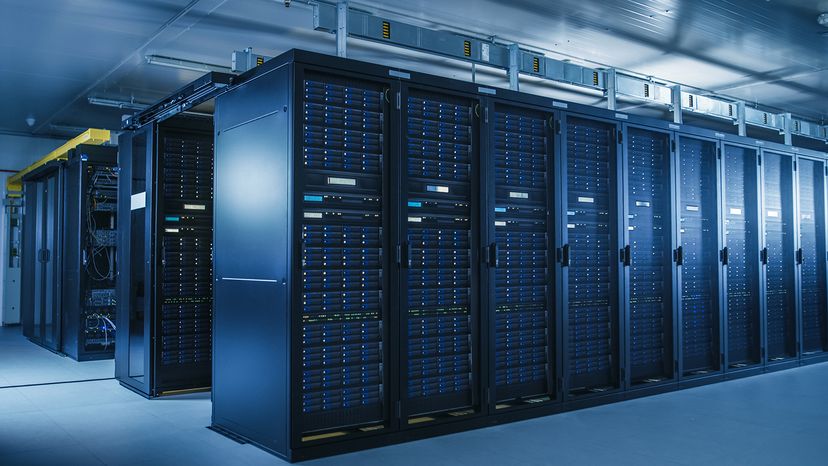
Altogether, U.S. data centers consumed an estimated 174 billion gallons (659 billion liters) of water in 2020. Gorodenkoff / Shutterstock
In our increasingly digital world, data centers are the unseen backbone of the internet.
Behind every search query, video stream, or artificial intelligence request is a cooling system that raises a critical question: Why do data centers need water?
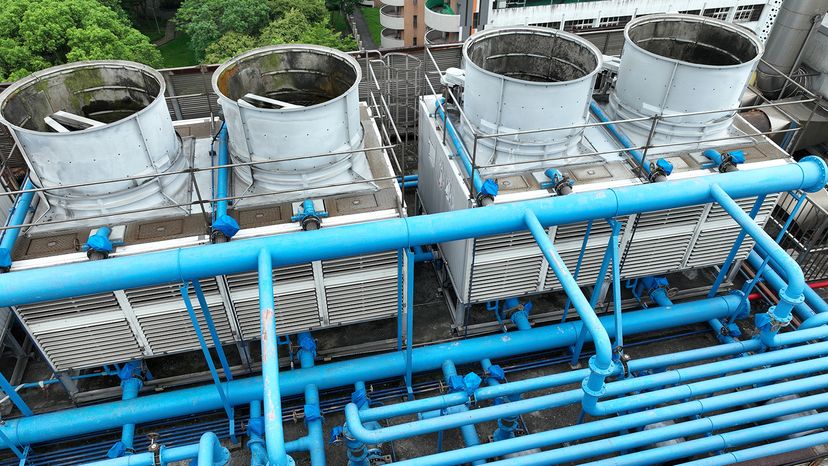
These liquid cooling towers are for an AI high-performance computing (HPC) data center. eric1207cvb / Shutterstock
Data centers house thousands of servers that generate a tremendous amount of heat. Without cooling, these machines would overheat and fail.
That’s where water comes in. Many data centers use evaporative cooling or closed-loop cooling systems to keep temperatures stable.
Advertisement
Water is often more efficient than air cooling because it transfers heat more effectively. This helps reduce energy consumption and improves energy efficiency.
Cold water or liquid coolant is circulated through heat exchangers to absorb hot air from server racks, which is then cooled again for reuse.
Advertisement
Data Center Water Usage
Most data centers use water in some form, especially large data centers operated by major tech companies like Google.
In 2023, Google reported consuming over 6 billion gallons (22.7 billion liters) of water to cool all its data centers. Water consumption is used as part of a strategy to balance energy usage and environmental impact.
Advertisement
The amount varies by region and cooling method. Some facilities use over 1 million gallons (3.8 million liters) per day.
In 2020, U.S. data centers collectively used an estimated 174 billion gallons (659 billion liters) of water, mostly for cooling. That’s enough to fill over 260,000 Olympic-sized swimming pools.
Advertisement
How Many Data Centers Are in the U.S.?
The United States leads the world in data center deployment. As of early 2024, there were more than 5,300 data centers in the U.S., spread across nearly every state.
Virginia, Texas, and California have the highest concentrations, largely due to connectivity, power access, and favorable climate conditions.
Advertisement
Many new data center projects are planned in water stressed regions, increasing the urgency for better water management practices.
What Do Data Centers Look Like?
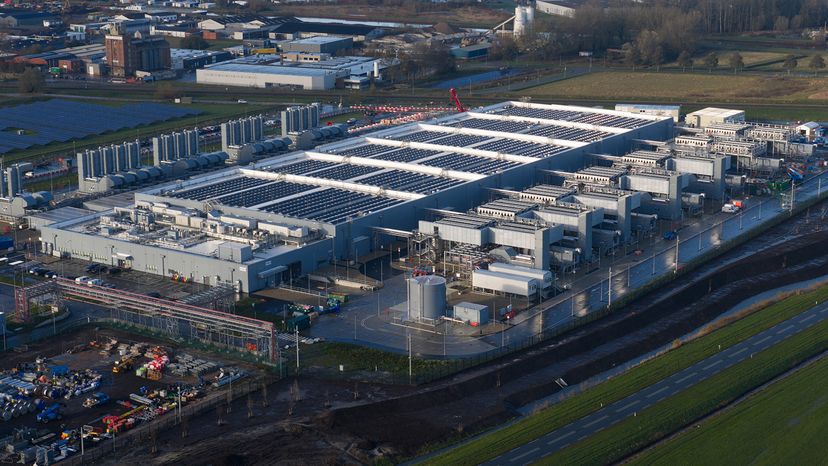
Data centers look like giant warehouses. Make more Aerials / Shutterstock
From the outside, data centers resemble giant industrial warehouses. They’re often windowless and can span hundreds of thousands of square feet. Inside, rows of server racks line climate-controlled rooms, with hot air containment systems, cooling towers, and backup generators.
The facilities also feature massive power and water infrastructure, including tanks, heat exchangers, and pipes that circulate water or liquid coolant.
Advertisement
In some locations, these buildings blend into suburban business parks, while others are in remote areas optimized for energy efficiency and water conservation.
Energy and Water Tradeoffs
Water cooling systems help lower carbon emissions by reducing reliance on fossil fuel power plants for energy-intensive air cooling.
But that benefit comes with tradeoffs. Cooling towers evaporate water during the process, meaning data centers rank among the top 10 water-consuming industries in the U.S.
Advertisement
To reduce impact, some companies are using recycled water, reclaimed water, or non-potable water to meet their cooling needs. Others are investing in immersion cooling and water usage effectiveness metrics to improve water management.
The Future of Sustainable Cooling
Data center operators are working with government officials and local water supply agencies to ensure long-term sustainability. Water availability and water quality are now key considerations for any new data center project.
The goal is to cool data centers efficiently while conserving natural water resources. Solutions include using surface water instead of potable water, capturing and reusing heated water, and operating with a constant supply of cooler air in naturally cooler climates.
Advertisement
As the data center industry continues to grow, managing water usage will be just as critical as managing energy. It’s a balance between supporting the digital world and protecting our planet’s most valuable resources.
We created this article in conjunction with AI technology, then made sure it was fact-checked and edited by a HowStuffWorks editor.
Advertisement
Cite This!
Please copy/paste the following text to properly cite this HowStuffWorks.com article: