Introduction to How Netflix Works

Image courtesy Netflix Media Center
Netflix is a highly successful online movie rental service. See more DVD pictures.
When Reed Hastings founded Netflix in 1997, his idea didn't make sense to a lot of people. DVD players had only been on the market for a few months, and many families were still using VHS tapes to watch movies. In spite of that, Netflix's movie inventory consisted exclusively of DVDs. Nay-sayers also doubted that people would want to wait for home delivery when video rental stores seemed to be everywhere. Critics wondered whether Netflix's unlimited subscription plans, launched in 1999, would be profitable.
Now, close to 10 years after opening its virtual doors, Netflix has nearly 6.8 million subscribers. [Source: Netflix]. In 2006, its estimated total revenue was more than $1.2 billion [Source: Netflix]. The company's goal is to have 20 million subscribers by 2012 -- that's about 20 percent of the households in the United States [Source: Business Week].
It can be difficult to pinpoint exactly where this success has come from. Some argue that it's the breadth of movies that Netflix offers; its library has around 75,000 different titles. Others contend that Netflix has been successful because it has attracted customers who want to watch a variety of movies rather than just new releases. Only about 30 percent of Netflix rentals are newly-released DVDs, but at most video-rental stores, 70 percent of rentals are new movies. [Source: Business Week].
At the Movies |
This requires DVD stores to continually procure and eventually dispose of or sell lots of copies of the same title, while Netflix is able to purchase fewer new copies and continue mailing out older movies. Netflix circulates 95 percent of its titles every three months. Since some of the titles are more popular than others and are requested more of the time, this translates to 35,000 of the 75,000 titles in circulation every day [Source: Netflix].
There's a lot going on, both on the Netflix Web site and behind the scenes, to allow Netflix to deliver so many movies to so many people. In this article, we'll look into how Netflix delivers discs and decides which movies to recommend to you. We'll also explore the company's competition and the issues it may face in the future.
Netflix Web Site and Envenlope
Netflix Theft Netflix envelopes are solid red, so they stand
out from the rest of the mail. This may make it easier for thieves to steal
other people’s DVDs. In 2006, newspapers featured stories of postal employees
borrowing or stealing hundreds of Netflix DVDs from customers on their routes.
New York Magazine reported that a postal worker in Lyons, Colorado
stole 503 discs before being arrested. |
The two most visible parts of the Netflix enterprise are the red mailing envelopes and the Web site. The patented envelope is essentially an ordinary mailing envelope with an extra long, removable flap. This extra length of paper is what lets DVDs make the round trip from the Netflix distribution center to your home in just one envelope. When the envelope travels to you, the flap displays your address while covering up the shipping center's return address. You remove the flap when you seal the envelope to return it to Netflix, so only the shipping center's address remains.
The envelope has been through several revisions as Netflix has refined its shipping methods and tried to become more profitable. These include:
- The addition of advertisements on the back of the flap
- The addition of a small slot that displays the barcode of the disc inside
- The removal of instructions on how to place the disc in the mailer
The Netflix Web site has been through numerous revisions as well. The company has made major changes to the site as often as every two weeks, constantly evaluating how the changes affect the business. Numerous features have come and gone, but for the most part, the site has looked a lot like other online retail stores. The available movies appear as thumbnail images, sometimes in conjunction with a brief description. When you hold your mouse pointer over a selection, the site pulls a lengthier description from a database and displays it on the screen. This description includes information about the movie's plot, cast and MPAA rating. Clicking on a title takes you to a separate page with cast and crew information, technical specifications and rating information from Common Sense Media, a separate company with its own Web site.
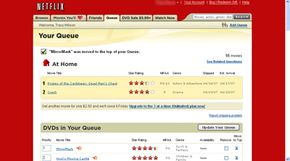
![]() The Netflix queue |
Watch Now In January 2007, Netflix announced that it was beginning
a six-month roll-out of a new video-on-demand service. The Watch Now service
allows subscribers to watch movies in a streaming
format for a certain number of minutes each month, depending on their
subscription plans. This service works only on computers running Microsoft
Windows XP Service Pack 2 or Windows Vista. It also requires a broadband
Internet connection and Internet Explorer 6.0 or better. |
You can browse the section by genre, check out critics' reviews or use the Netflix Top 100 to decide which movies you want to see. You can also use the Friends feature to see what your friends are watching and compare which movies you like. When you find a movie you want to see, you add it to your queue. If you want to see movie that Netflix doesn't have in its inventory yet, you can save it for later. Netflix ships your movies in the order in which they appear in your queue, and you can change the order or remove movies entirely as often as you want.
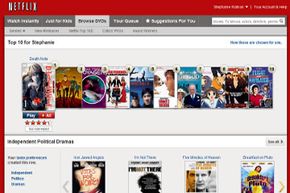
As you browse, you have three options for each movie you see on the site. You can give it a star rating, add it to your queue or tell Netflix that you're not interested in it. The choices you make dramatically affect which movies Netflix features on the site when you visit. Next, we'll take a look at the Netflix recommendation engine and how it works.
Netflix Recommendations
One of the reasons why so many Netflix rentals are older movies rather than new releases is that the site automatically recommends films based on customers' viewing habits. Such recommendation programs are known as collaborative filtering systems. According to Netflix, 60 percent of subscribers add these suggested movies to their queues [Source: Netflix Consumer Press Kit]. These recommendations come from the entire Netflix library, not just the new releases or the mainstream films. In other words, Netflix uses its recommendation system to keep more of its library in circulation more of the time.
![]() Netflix's suggestions, or "Movies You'll Love," are based on your viewing habits |
The Netflix Web site makes these recommendations automatically using a system called CineMatch. CineMatch is a database that uses information from three sources to determine which movies customers are likely to enjoy:
- The films themselves, which are arranged as groups of common movies
- The customers' ratings, rented movies and current queue
- The combined ratings of all Netflix users
The CineMatch database updates itself constantly and makes thousands of recommendations every second, or close to a billion total predictions every day. It all starts after you open your Netflix account and visit the "Movies You'll Love" section on the site. First, you enter your genre preferences into the database. Then, you rate a selection of movies with one to five stars. If you hated a movie, you give it one star, but if you loved it, you give it five. The more movies you rate, the more accurate your recommendations become. On average, Netflix members have about 200 rated movies in their profiles, and the system matches these to 1.7 billion total ratings [Source: Netflix Consumer Press Kit].
![]() Getting good recommendations starts with creating a baseline by rating several movies. |
Making a good movie recommendation may seem like something that would require instinct or emotion. For example, if you recommend a movie you've seen to a friend, you take into account how the movie made you feel, your tastes and your friend's tastes. CineMatch, on the other hand, is all math. It matches your viewing and rating history with people who have similar histories. It uses those similar profiles to predict which movies you are likely to enjoy. That's what these recommendations really are - predictions of which movies you will like. According to Netflix, these predictions are accurate within half a star 75 percent of the time, and half of Netflix users who rent recommended movies give them a five-star rating [Source: Netflix Investor Press Kit].
The Netflix Prize The CineMatch system's 75 percent accuracy rate seems to be fairly
respectable, especially since it involves something as hard to quantify
as whether people like a movie. However, Netflix wants to improve the
system. The company has established a 5-year contest called the Netflix
Prize. It has released 100 million ratings collected over a 7-year
period and invited people to use them to find a more accurate
algorithm. The goal is to improve the system's accuracy by 10 percent,
and the prize is $1 million. |
These predictions rely on algorithms and statistics. It starts by matching movies to each other rather than matching people to movies, since there are far fewer titles in the library than there are Netflix subscribers. To make matches, a computer:
- Searches the CineMatch database for people who have rated the same movie - for example, "The Return of the Jedi"
- Determines which of those people have also rated a second movie, such as "The Matrix"
- Calculates the statistical likelihood that people who liked "Return of the Jedi" will also like "The Matrix"
- Continues this process to establish a pattern of correlations between subscribers' ratings of many different films
The CineMatch system can then compare these patterns to your ratings. It uses a statistical process called a multivariate regression to determine which other movies you will probably like. The database updates itself with new ratings and correlations, or conditions its data, constantly. In a way, the system learns how people watch movies.
Often, these predictions make logical sense. A Netflix customer who gives two movies in the "Lord of the Rings" trilogy five stars is likely to enjoy the third film as well. However, Netflix users who spend a lot of time rating their movies and looking at their recommendations may find some surprising correlations. This is because the algorithms that keep the CineMatch system running don't necessarily have anything to do with the plot or cast. Instead, they have to do with other subscribers' rental and ratings histories.
![]() According to the CineMatch system, subscribers who enjoy both Eddie Izzard's stand-up comedy routines and "Welcome to the Dollhouse," a movie about the unpleasantness of junior high school, will also enjoy the documentary "Life in the Undergrowth." |
According to one article in the "New York Times," this recommendation system has significantly changed people's movie preferences. It has given independent releases and films that did not succeed at the box office a wider distribution [Source: New York Times]. As more Netflix subscribers see and rate these lesser-known films, the CineMatch system recommends them to more people.
Regardless of whether someone is renting a classic movie, an independent film or a new release, the Netflix distribution system handles it in the same way. We'll look at how movies get to your home and back to Netflix in the next section.
Netflix Shipping and Receiving
![]() Image courtesy Netflix Media Center A Netflix employee opens a returned envelope |
In the early days of Netflix, the company had one major advantage over its rent-by-mail competitors. While other companies had one central distribution center, Netflix had several scattered around the United States. This cut down on the amount of time that customers’ DVDs spent in transit. Today, Netflix has more than 40 distribution centers strategically located throughout the United States. This allows 90 percent of subscribers to get their DVDs the day after Netflix ships them. The return trip takes the same amount of time.
Netflix also processes nearly all of the DVDs it receives on the day they arrive. Each weekday, the United States Postal Service (USPS) delivers thousands of DVDs to each Netflix shipping center. Employees open the envelopes and scan a UPC barcode on the sleeve containing the DVD. The Netflix inventory system automatically updates the subscriber’s queue and sends an e-mail message reporting that the DVD has arrived. An employee then inspects the DVD to make sure it isn’t broken or too damaged to play and returns it to the shipping center’s inventory.
Like the receiving process, the shipping process requires both people and machines. An inventory control system makes sure that subscribers haven’t exceeded their allotted rentals per month or allotted number of DVDs rented at a time. It then matches subscribers’ queues with inventory information for each shipping center to let employees know which DVDs to ship. Employees place each white DVD sleeve into a red mailing envelope. People seal the envelopes, but machines apply the small, round stickers that keep the paper flaps secure during transit. Machines also take care of sorting all of the outgoing DVDs into bins destined for the right ZIP code. This process is similar to the automated sort that happens at a UPS shipping center or at USPS facilities. At the end of the day, the USPS picks up the DVDs that are destined for home delivery.
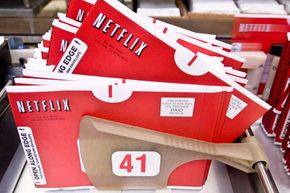
![]() Image courtesy Netflix Media Center Neflix envelopes being sorted |
For the most part, this process, with its one-day delivery and same-day processing, is fairly efficient. It allows Netflix to deliver 1.5 million DVDs through the USPS every day - Netflix delivered its billionth DVD on February 25, 2007. However, a number of factors can affect which DVDs you get and when you get them. One is the rarity of the DVD. If there aren’t many copies in the system, Netflix may have to ship one from a center that is far from where you live. Another is the popularity of the movies you want to watch. For newly-released films, Netflix may have fewer copies of the film than there are people who want to see it. In some cases, new releases have wait times of days or months.
If you watch lots of DVDs from Netflix every month, it may also take longer for you to get to the top of the waiting list for extremely popular movies. According to Netflix, this is to give the best possible service to all customers. However, critics of the practice refer to it as throttling and say that it puts Netflix’s best customers at a disadvantage. Although Netflix claims it has always given its least-frequent renters the highest priority for new titles, it didn’t always disclose this fact in its terms of use. For this reason, the throttling debate led to a class-action lawsuit - Frank Chavez v. Netflix Inc. - by users who accused the company of wrongdoing. Netflix settled the suit in 2006, but the settlement is currently in appeals.
Subscribers have also questioned the quality of the Netflix shipping process. DVDs travel to subscribers’ homes and back in plain, unpadded envelopes, and many discs spend a lot of time being handled and shipped. For these reasons, some people receive broken, scratched or otherwise unplayable DVDs. Critics claim that Netflix uses inadequate packaging to improve its bottom line and even accuse the company of willfully distributing defective discs. However, Netflix has been a member of the Better Business Bureau since 2001, and the Better Business Bureau has given the company a satisfactory rating.
In addition to throttling and quality concerns, Netflix faces fierce competition from several directions. People have plenty of other choices for renting DVDs, including video stores, other rent-by-mail services and movie download services. In addition, Netflix cites DVD sales and movie piracy as potential threats.
Netflix has also faced intense competition from Blockbuster, which introduced its Total Access program in late 2006. This program supplemented Blockbuster’s existing rent-by-mail service, which it launched in 2004. Total Access allows subscribers to rent movies by mail. In addition, subscribers can return their DVDs to a local Blockbuster store and pick up a free DVD rental while they’re there. This free rental is just like any other in-store Blockbuster rental - it has a due date and has to be returned to the store in person. In the first quarter of 2007, Netflix reported that Blockbuster’s new program had caused its growth to slow. Netflix also alleged that Blockbuster’s rent-by-mail programs infringed on its patents.
Some analysts suggest that Blockbuster’s focus on following Netflix’s rent-by-mail model will be its undoing [Source: SeekingAlpha]. Netflix CEO Reed Hastings has claimed that Blockbuster is only a short-term threat and that its Total Access program won’t be profitable at competitive prices [Source: Motley Fool, Motley Fool]. Only time will tell which company will become more profitable and whether people will continue to rent DVDs by mail as streaming video technology continues to improve.
For more information on Netflix and related topics, check out the links on the next page.
Lots More Information
Related HowStuffWorks Articles
More Great Links
Sources
- Agassi, Shai et al. "Methods and Systems for Providing Contextual Content." U.S. Patent 7127473.
- Associated Press. "Frequent Netflix Renters Sent to the Back of the Line." Via MSNBC. 2/10/2006 (4/30/2007)
http://www.msnbc.msn.com/id/11262292/ - Netflix. "Consumer Press Kit."
http://cdn-0.nflximg.com/us/pdf/Consumer_Press_Kit.pdf - Better Business Bureau: Silicon Valley. "Netflix."
http://www.bbbsilicon.org/commonreport.html?bid=206533&securitycode= - Bylund, Anders. "Fool on Call: Netflix Punished for Planning Ahead." The Motley Fool. 4/23/2007 (4/30/2007)
http://www.fool.com/investing/general/2007/04/23/ fool-on-call-netflix-punished-for-planning-ahead.aspx - Calonje, Ligia S. et al. "Mailing and Response Envelope." U.S. Patent 6966484.
- Cohen, Allen. "Netflix: DVDs At Your Door." PC Magazine. 2/03 (4/30/2007)
http://findarticles.com/p/articles/mi_zdpcm/is_200302/ai_ziff37297 - Cruise, Patrick. "Blockbuster's Online Focus is Killing its Competitive Advantage." SeekingAlpha. 4/17/2007 (4/30/2007)
http://media.seekingalpha.com/article/32374 - Hastings, W. Reed et al. "Approach for Renting Items to Customers." U.S. Patent 7024381.
- Hastings, W. Reed et al. "Method and Apparatus for Renting Items" U.S. Patent 6584450.
- Hastings, Reed. "The Real Stars." Forbes. 5/7/2007 (4/30/2007)
http://www.forbes.com/free_forbes/2007/0507/130.html? partner=yahoomag - Leonhardt, David. "What Netflix Could Teach Hollywood." New York Times. 6/7/2006 (4/30/2007)
http://www.nytimes.com/2006/06/07/technology/07leonhardt.html? ex=1307332800&en=f5560e6361bf4018&ei=5090 - McGregor, Jena. "High-tech Achiever: Netflix." FastCompany. 10/2007 (4/30/2007)
http://www.fastcompany.com/magazine/99/open_customer-netflix.html - Motley Fool. "What is Netflix's Greatest Threat?" 2/2/2005 (4/30/2007).
http://www.fool.com/investing/high-growth/ 2005/02/02/what-is-netflixs-greatest-threat.aspx - Mullaney, Timothy J. "Netflix: The Mail-order Movie House that Clobbered Blockbuster." BusinessWeek. 5/25/2006 (4/30/2007).
http://www.businessweek.com/smallbiz/content/ may2006/sb20060525_268860.htm - Netflix Shareholder Press Kit
http://files.shareholder.com/downloads/NFLX/120021947x0x24776/ 1F1055CB-DCBB-475A-87CD-03F6091D4901/factsheet.pdf - News8. "News8 Exclusive: Business Guards its Secrets of Success." 2/8/2006 (4/30/2007)
http://www.cbs8.com/features/special_assignment/story.php?id=38163 - O'Brien, Jeffrey M. "The Netflix Effect." Wired. 12/2002 (4/30/2007)
http://www.wired.com/wired/archive/10.12/netflix.html? pg=1&topic=&topic_set= - Porter, Joshua. "The Freedom of Fast Iterations: How Netflix Designs a Winning Web Site." User Interface Engineering. 11/14/2006 (4/30/2007)
http://www.uie.com/articles/fast_iterations/ - Wolff, Eric. "A Stranger in your Queue." New York Magazine. 2/20/2006 (4/30/2007)
http://nymag.com/news/intelligencer/15961/