Holographic versatile discs offer far more storage capacity than CDs and DVDs. Kseniya Ovchinnikova / Getty Images
Holographic memory systems have been around for decades. They offer far more storage capacity than CDs and DVDs -- even "next-generation" DVDs like Blu-ray -- and their transfer rates leave conventional discs in the dust. So why haven't we all been using holographic memory for years now?
There are several hurdles that have been holding holographic storage back from the realm of mass consumption, including price and complexity. Until now, the systems have required a cost-prohibitive level of precision in manufacturing. But recent changes have made the holographic versatile disc (HVD) developed by Optware a viable option for consumers.
Advertisement
In this article, we'll find out how the HVD works, how it has improved upon previous methods of holographic storage and how it stacks up to Blu-ray and HD-DVD.
The first step in understanding holographic memory is to understand what "holographic" means. Holography is a method of recording patterns of light to produce a three-dimensional object. The recorded patterns of light are called a hologram.
The process of creating a hologram begins with a focused beam of light -- a laser beam. This laser beam is split into two separate beams: a reference beam, which remains unchanged throughout much of the process, and an information beam, which passes through an image. When light encounters an image, its composition changes (see How Light Works to learn about this process). In a sense, once the information beam encounters an image, it carries that image in its waveforms. When these two beams intersect, it creates a pattern of light interference. If you record this pattern of light interference -- for example, in a photosensitive polymer layer of a disc -- you are essentially recording the light pattern of the image.
Advertisement
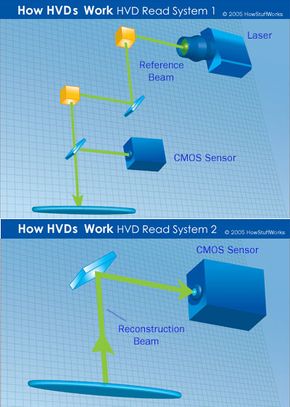
To retrieve the information stored in a hologram, you shine the reference beam directly onto the hologram. When it reflects off the hologram, it holds the light pattern of the image stored there. You then send this reconstruction beam to a CMOS sensor to recreate the original image.
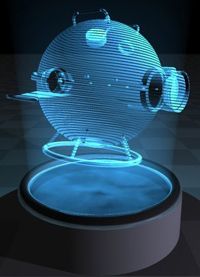
Most of us think of holograms as storing the image of an object, like the Death Star pictured above. The holographic memory systems we're discussing here use holograms to store digital instead of analog information, but it's the same concept. Instead of the information beam encountering a pattern of light that represents the Death Star, it encounters a pattern of light and dark areas that represent ones and zeroes.
DVD vs. HVD: Recording-layer depth
Courtesy Optware
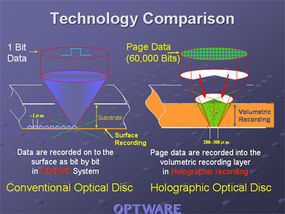
HVD offers several advantages over traditional storage technology. HVDs can ultimately store more than 1 terabyte (TB) of information -- that's 200 times more than a single-sided DVD and 20 times more than a current double-sided Blu-ray. This is partly due to HVDs storing holograms in overlapping patterns, while a DVD basically stores bits of information side-by-side. HVDs also use a thicker recording layer than DVDs -- an HVD stores information in almost the entire volume of the disc, instead of just a single, thin layer.
Volumetric recording method
Courtesy Optware
The other major boost over conventional memory systems is HVD's transfer rate of up to 1 gigabyte (GB) per second -- that's 40 times faster than DVD. An HVD stores and retrieves an entire page of data, approximately 60,000 bits of information, in one pulse of light, while a DVD stores and retrieves one bit of data in one pulse of light.
Now that we know the premise at work in HVD technology, let's take a look at the structure of the Optware disc.
Advertisement
The Holographic Versatile Disc
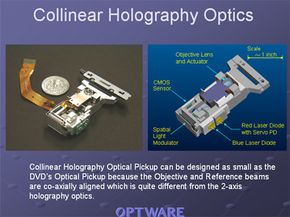
HVD optical pickup
Courtesy Optware
Holographic memory has been around for more than 40 years, but several characteristics made it difficult to implement in a consumer market. First off, most of these systems send the reference beam and the information beam into the recording medium on different axes. This requires highly complex optical systems to line them up at the exact point at which they need to intersect. Another drawback has to do with incompatibility with current storage media: Traditionally, holographic storage systems contained no servo data, because the beam carrying it could interfere with the holography process. Also, previous holographic memory discs have been notably thicker than CDs and DVDs.
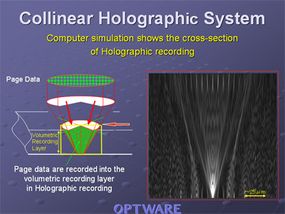
Optware has implemented some changes in its HVD that could make it a better fit for the consumer market. In the HVD system, the laser beams travel in the same axis and strike the recording medium at the same angle, which Optware calls the collinear method. According to Optware, this method requires a less complex system of optics, enabling a smaller optical pickup that is more suited to consumer use.
Advertisement
HVD also includes servo data. The servo beam in the HVD system is at a wavelength that does not photosensitize the polymer recording medium. In the HVD test system, the servo data is carried in a red (650-nm wavelength) laser. The size and thickness of an HVD is also compatible with CDs and DVDs.
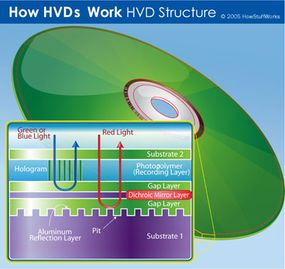
The structure of the disc places a thick recording layer between two substrates and incorporates a dichroic mirror that reflects the blue-green light carrying the holography data but allows the red light to pass through in order to gather servo information.
Because Optware's HVD system is currently in the late stages of research and development, complete technical information is unavailable for public consumption. But in the next section, we'll discuss a simplified version of the system that covers the major aspects of HVD.
Competitors
Besides Optware, there are several other companies racing to get their consumer-friendly holographic storage system to market. One product in the running is Inphase Technologies' Tapestry(tm) disc, which could be on shelves as early as November 2006. See InPhase Technologies to learn more.
Advertisement
The HVD System: Writing Data
A simplified HVD system consists of the following main components:
Blue or green laser (532-nm wavelength in the test system)
Beam splitter/merger
Mirrors
Spatial light modulator (SLM)
CMOS sensor
Photopolymer recording medium
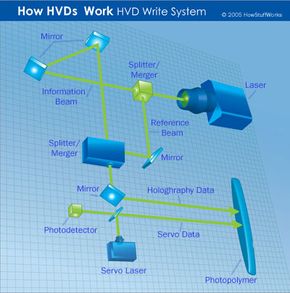
The process of writing information onto an HVD begins with encoding the information into binary data to be stored in the SLM. These data are turned into ones and zeroes represented as opaque or translucent areas on a "page" -- this page is the image that the information beam is going to pass through.
Advertisement
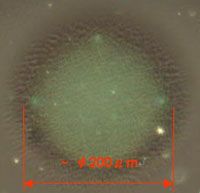
Page data stored as a hologram
Photo courtesy Optware
Once the page of data is created, the next step is to fire a laser beam into a beam splitter to produce two identical beams. One of the beams is directed away from the SLM -- this beam becomes the reference beam. The other beam is directed toward the SLM and becomes the information beam. When the information beam passes through the SLM, portions of the light are blocked by the opaque areas of the page, and portions pass through the translucent areas. In this way, the information beam carries the image once it passes through the SLM.
When the reference beam and the information beam rejoin on the same axis, they create a pattern of light interference -- the holography data. This joint beam carries the interference pattern to the photopolymer disc and stores it there as a hologram.
A memory system isn't very useful if you can't access the data you've stored. In the next section, we'll find out how the HVD data-retrieval system works.
Advertisement
The HVD System: Reading Data
To read the data from an HVD, you need to retrieve the light pattern stored in the hologram.
In the HVD read system, the laser projects a light beam onto the hologram -- a light beam that is identical to the reference beam (Read System 1 in the image above). The hologram diffracts this beam according to the specific pattern of light interference it's storing. The resulting light recreates the image of the page data that established the light-interference pattern in the first place. When this beam of light -- the reconstruction beam -- bounces back off the disc (Read System 2), it travels to the CMOS sensor. The CMOS sensor then reproduces the page data.
Advertisement
Now let's take a look at how HVD compares to other next-generation storage media.
How HVD Compares
While HVD is attempting to revolutionize data storage, other discs are trying to improve upon current systems. Two such discs are Blu-ray and HD-DVD, deemed the next-generation of digital storage. Both build upon current DVD technology to increase storage capacity. All three of these technologies are aiming for the high-definition video market, where speed and capacity count. So how does HVD stack up?
Because HVD is still in the late stages of development, nothing is written in stone; but you've probably noticed that the projected introductory price for an HVD is a bit steep. An initial price of about $120 per disc will probably be a big obstacle to consumers. However, this price might not be so insurmountable to businesses, which are HVD developers' initial target audience. Optware and its competitors will market HVD's storage capacity and transfer speed as ideal for archival applications, with commercial systems available as soon as late 2006. Consumer devices could hit the market around 2010.
Advertisement
For more information on HVD and related topics, check out the links on the next page.