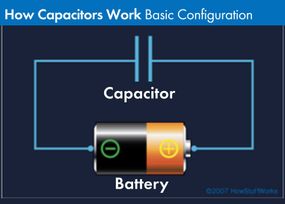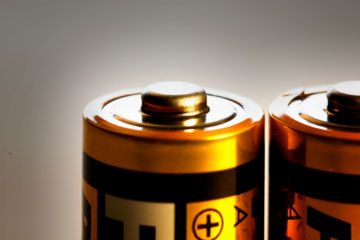
In a way, a capacitor is a little like a battery. Although they work in completely different ways, capacitors and batteries both store electrical energy. If you have read How Batteries Work, then you know that a battery has two terminals. Inside the battery, chemical reactions produce electrons on one terminal and the other terminal absorbs them when you create a circuit. A capacitor is much simpler than a battery, as it can't produce new electrons — it only stores them. A capacitor is so-called because it has the "capacity" to store energy.
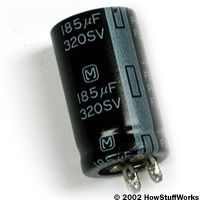
In this article, we'll learn exactly what a capacitor is, what it does and how it's used in electronics. We'll also look at the history of the capacitor and how several people helped shape its progress.
Advertisement
Capacitors can be manufactured to serve any purpose, from the smallest plastic capacitor in your calculator, to an ultra capacitor that can power a commuter bus. Here are some of the various types of capacitors and how they are used.
- Air: Often used in radio tuning circuits
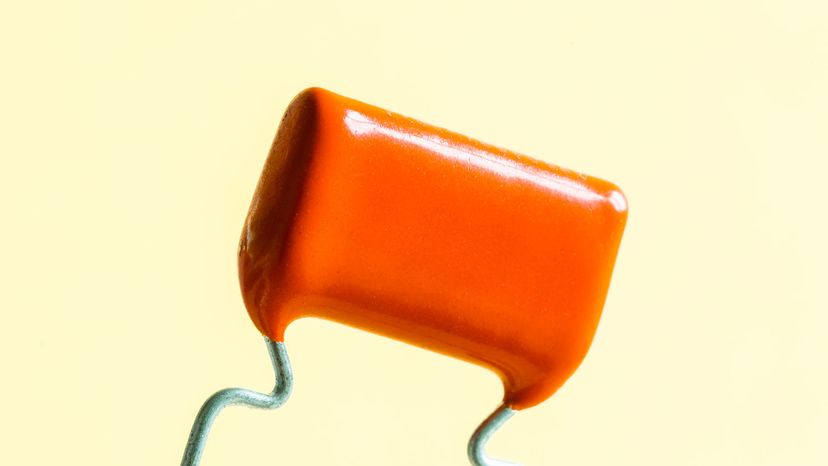
- Mylar: Most commonly used for timer circuits like clocks, alarms and counters
- Glass: Good for high-voltage applications
- Ceramic: Used for high frequency purposes like antennas, X-ray and MRI machines
- Super capacitor: Powers electric and hybrid cars
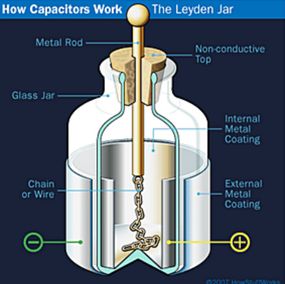
Inside a capacitor, the terminals connect to two metal plates separated by a non-conducting substance, or dielectric. You can easily make a capacitor from two pieces of aluminum foil and a piece of paper (and some electrical clips). It won't be a particularly good capacitor in terms of its storage capacity, but it will work.
In theory, the dielectric can be any non-conductive substance. However, for practical applications, specific materials are used that best suit the capacitor's function. Mica, ceramic, cellulose, porcelain, Mylar, Teflon and even air are some of the non-conductive materials used. The dielectric dictates what kind of capacitor it is and for what it is best suited. Depending on the size and type of dielectric, some capacitors are better for high-frequency uses, while some are better for high-voltage applications.
Advertisement