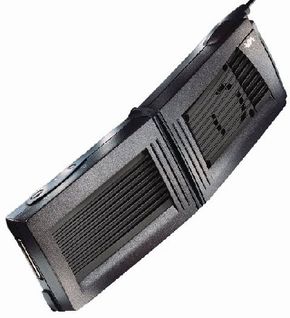
Work on ViA's universal translator began about two years ago as a way to ensure that people of different languages can communicate with each other in life-and-death situations. Robert Palmquist, ViA's vice president of innovative technology, described the tragedy that sparked the development of the ViA translator. A few years ago, several people died in a fire in St. Paul, MN, because firefighters were unable to communicate effectively with the victims. Non-English speaking residents of the building were trying to flee, but misunderstood where the firefighters were telling them to go and walked directly into the fire. It's possible that if the firefighters would have had a translating device, the fatalities could have been avoided.
Currently, the device is only designed for English-speaking users, because ViA believes the target audience for this device is English speakers. Here's how the device will work:
- When the user talks, his or her voice is detected by the device's voice recognition software.
- A customized speech and translation engine will then determine what the person is saying and translate it.
- Five seconds after the English speaker finishes talking, the translated words are projected by the device's speaker to provide near-real-time translation.
- Responses from whoever the user is talking to will then be translated back into English, allowing bidirectional translation.
Initially, the device will be able to translate English into about a dozen languages, including Korean, Serbian, Arabic, Thai, Mandarin Chinese, French, German, Italian, Portuguese and Spanish. Obviously, the device will not be able to translate word-for-word, but it will get across the gist of what the user is saying. The device is very smart. It allows for differences in English accents, such as the difference between accents in Houston and Boston. It also has a dictionary stacking function, which allows users to add jargon and slang to the standard dictionary installed on the device.
The value of such a device was clear to the U.S. Office of Naval Research (ONR), which invested money for ViA to develop the automatic translator. Joel Davis, program director at ONR, said that the device could replace human translators, who are expensive to train and whose skills tend to diminish over time. Davis says that one translating device would be allotted for a group of 12 soldiers in the field, and the device would facilitate basic verbal interaction with native residents.
A body-worn translator would benefit not only the military, but would also be valuable to tourists, airport personnel, phone operators, and border patrol and customs agents. In the future, we may all wear a tiny wearable translator in order to remove one of the biggest barriers to communication across cultures.