Police Robot Movement

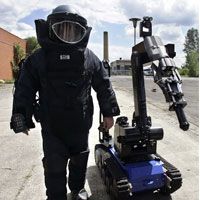
A few companies manufacture police robots, and some produce different models based upon the needs and resources of different police forces. No two models are exactly the same, but most models share basic features and functions.

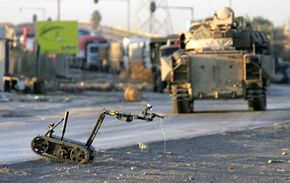
This robot moves on treads rather than wheels.
John Moore/ Getty Images
This robot moves on treads rather than wheels.

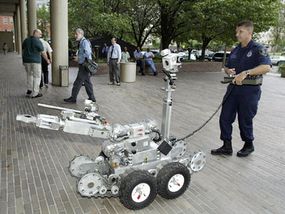
Because it's tricky to design a robot that walks on legs, police robots usually get around on rubber tires or treads. Some models have pneumatic wheels that are easy to remove and replace, decreasing the space needed to store or transport the machine. Many models also have individually powered wheels, making it easier for the operator to navigate rough terrain -- he can cut power to any wheel not in contact with the ground and redirect traction to the other wheels. Some models have track-mounted wheels with articulation -- the tracks can flex to meet the contours of the ground. A few can even climb stairs.

Sophisticated robots require a hefty power source. If the robot isn't tethered to a power source with a cable, it needs an onboard battery. Because most robots weigh hundreds of pounds (over 800 pounds for some models), they need batteries that can deliver significant levels of power for several hours at a time. For this reason, police robots use lead-acid batteries, the same sort of batteries used in cars.

Cut the Green Wire! No, the Red Wire!
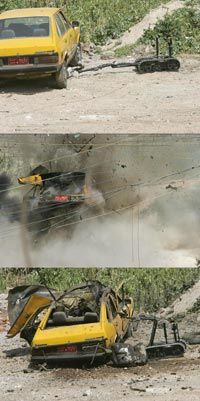
Police can sometimes disarm a bomb using a robot's gripping tool, though it's more common for cops to use the robot to remove a bomb and transport it to a special container for detonation. Robots aren't quite sophisticated enough yet to disarm complex devices. Occasionally, police might opt to use the robot to deliver a small explosive charge to detonate the bomb without removing it [source: USA Today].

Robots used to manipulate objects like bombs or hazardous materials need a robotic arm. Robotic arms usually have several points of articulation or joints. The arm might have the same capabilities of a human arm, with shoulder, elbow and wrist articulation, or it may have many more joints, allowing the operator to reach places he wouldn't be able to get to on his own. On the end of the arm is a manipulator, usually a gripping device in the form of a two-fingered claw.

Because the officer controlling the robot is at least several meters away from the robot, he needs a way to see the robot's environment independent of his own perspective. For this reason, police robots use video cameras to broadcast images back to the operator's laptop or console. Most robots use at least two or three cameras so that the operator can stay aware of the robot's surroundings. Some models have a camera mounted on every point of articulation, as well as stationary cameras attached to the body of the robot. Video camera systems range from black-and-white to night vision and infrared.

Another feature many police robots have is a two-way audio system. Manufacturers mount microphones and speakers on the robot, allowing police to listen to sounds in the robot's environment or communicate with suspects or hostages in a dangerous situation. The robot can become the eyes and ears of the police force without a single officer being put in harm's way.

In the next section, we'll look at police robots in action.

All Weather, All Terrain
The companies that manufacture robots for police forces know that their product has to work within a wide range of conditions. Robots are typically housed in tough, weather-resistant casing and rely on mobility systems that can handle steep slopes, rocky ground or small obstacles. One thing most police robots are not is speedy -- most travel at speeds ranging from a slow crawl to a swift walk [source: Remotec].