Introduction to How Nintendo DS Works
Here's a question: What happens when one of the world's largest electronics companies makes a move to edge its competition out of the top spot in the portable gaming industry? If you're Nintendo, and Sony has made it clear that it wants to crush you with its new PlayStation Portable, you throw a curve ball and try to beat Sony with what you do best: innovation.
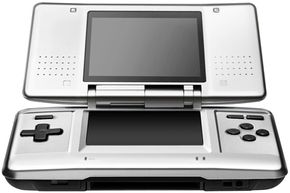
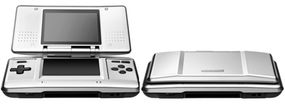
![]() Photo courtesy Nintendo of America, Inc. Nintendo DS is essentially a larger, two-screen game boy. See more pictures of Nintendo DS. |
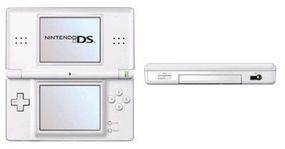
Nintendo's latest innovation is not a bigger, faster processor. Nintendo's latest foray into the handheld market, a market it practically owns thanks to the legendary Game Boy -- is the DS. "DS" stands for either "dual screen" or "developers' system," depending on which way the wind's blowing, and it's a cross between two Game Boys and a PDA, with a cell phone's messaging function thrown in for good measure. And the DS's new sidekick, DS Lite, has all the handheld glory of the DS plus brighter screens and a smaller, lighter, easier-to-pocket package.
So what's the big deal with the little DS? On the surface, it's just a larger, two-screened Game Boy. However, with its laundry list of handheld firsts, a multitude of possibilities are now open to game developers.
![]() Photo courtesy Nintendo of America, Inc. The DS |
![]() Photo courtesy Nintendo of America, Inc. The DS Lite |
DS Features:
- Two 3-inch, LCD screens capable of 3-D renderings
- Touch capabilities, using a stylus or a finger, on the bottom screen
- Microphone port
- Two kinds of wireless connectivity, IEEE 802.11 and a protocol proprietary to Nintendo
|
Nintendo once held the top spot in the home-console market thanks to its culture-altering, mega-hit NES; but Sony, the home-electronics giant, made it their mission to knock the company from the mountain top in the early '90s. With Sony's industry-dominant PlayStation and subsequent PlayStation 2, Nintendo saw its once nearly total market share decrease substantially. Sony's secret? -- going after older gamers, particularly males with the type of money needed to purchase games that can cost up to $60 or $70 dollars a pop, with features like DVD playback and games with adult-oriented material. Sony's weapon? -- the compact disc, which it foresaw as the emerging industry standard for media. While the rest of the industry switched from bulky plastic cartridges to CDs in an effort to catch up to Sony, Nintendo lagged behind. Now, Sony is determined to knock Nintendo from the top of the handheld market, as well, with the PSP, the PlayStation Portable. It boasts graphics on a par with the PlayStation 2 and the ability to support video and audio through a new type of mini disc. Nintendo, unable to compete with the PSP's graphics and Sony's nearly inexhaustible budget, has decided to reevaluate its options and see what it could do better than Sony. |
DS Features
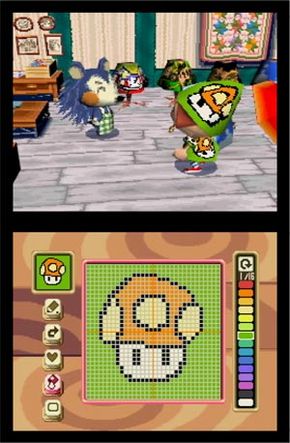
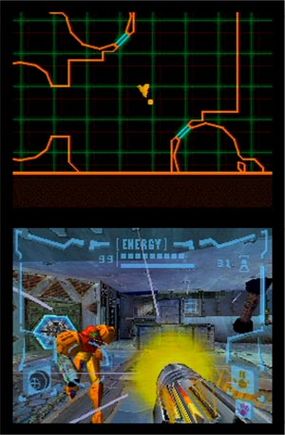
In creating the DS, Nintendo was aiming for a vehicle that allowed developers to do some exciting things never before seen in video gaming, let alone handheld gaming. Enter the two screens. Demos for the DS showed how some of those developers chose to navigate the new territory. Some games gave two completely different perspectives on the on-screen action, while others used the second screen to display gaming peripherals like maps, menus and object inventories.
![]() Photo courtesy Nintendo of America, Inc. Screen shot of Animal Crossing DS |
What Nintendo hopes is the most innovative aspect about the two screens, though, is that they allow for an entirely new input system in video gaming. For all of its dazzling innovations, video games are essentially still controlled by pushing (and pushing and pushing) buttons. With the DS touch screen, there is an entirely new world of controls that are now possible for gamers. At E3, some of the most lauded demos for the DS allowed gamers the ability to draw their way through a game, control characters through touch or use the stylus to "carve" objects onscreen to create digital sculpture.
![]() Photo courtesy Nintendo of America, Inc. Screen shot of Metroid Prime: Hunters |
And it's not strictly for gaming. Also on deck are applications that allow players to write messages, utilize an onscreen keyboard and send and receive text messages during game play.
|
The games for DS, which are about the size of a postage stamp and resemble some digital media memory cards, will fit in the smaller of the DS's two possible gaming slots. The larger slot, which allows the DS to play Game Boy Advance games, will also be used for a number of accessories that Nintendo has slated for future release. |
Microphone
|
|
Wireless
The DS also features wireless technology for connecting gamers to one another and the Internet. Many thought that Nintendo would install Bluetooth technology in the DS, but it opted for the stronger and wider range of IEEE 802.11.
Nintendo also looked to Xbox Live and its mega hit "Halo" for inspiration in allowing the DS to connect gamers to one another. Up to 16 people can play each other on the DS, and with a wireless LAN connection, that number could increase indefinitely. Add in the possibility of multiple players engaging in game sharing (using only one cartridge to allow many people to play the game), and you can see why some people in the video game industry are very excited about the handheld with two heads.
Tech Specs
|
|
- Size (closed): DS - 5.85" wide / 3.33" long / 1.13" tall; DS Lite - 5.24" wide / 2.91" long / 0.85" tall
- Weight: DS - 275 grams; DS Lite - 218 grams
- Upper Screen: Backlit, 3-inch, semitransparent reflective TFT color LCD with 256x192 pixel resolution and .24 mm dot pitch
- Touch Screen: Same as upper screen, but with transparant analog touch screen
- Brightness: DS - two settings; DS Lite - four settings
- Color: Capable of displaying 260,000 colors
- Wireless Communication: IEEE 802.11 and Nintendo's proprietary format; wireless range is 30 to 100 feet, depending on circumstances; multiple users can play multiplayer games using just one DS game card
- Controls: Touch screen, embedded microphone for voice recognition, A/B/X/Y face buttons, plus control pad, L/R shoulder buttons, Start and Select buttons
- Input/Output: Ports for both Nintendo DS game cards and Game Boy Advance Game Paks, terminals for stereo headphones and microphone
- Other Features: Embedded PictoChat software that allows up to 16 users to chat at once; embedded real-time clock; date, time and alarm; touch-screen calibration
- CPUs: One ARM9 and one ARM7
- Sound: Stereo speakers providing virtual surround sound, depending on the software
- Battery: Lithium ion battery delivering six to 10 hours of play on a four-hour charge, depending on use; power-saving sleep mode; AC adapter
- Languages: English, Japanese, Spanish, French, German, Italian
- Color: DS - Silver and black; DS Lite - White
The Future of Gaming?
![]() Photo courtesy Nintendo of America, Inc. Nintendo DS |
Nintendo's big bet is that what people want is something truly new and something fun. With the DS, Nintendo is trying to offer consumers the ability to experience video games in whole new ways. According to Reggie Fils-Aime, Nintendo of America's executive vice president of sales and marketing, "We've figured out the magic of what makes portable game play so attractive to consumers. We've defeated nine challengers (other handheld systems) and once again we're prepared to win."
The DS is only slightly more powerful than the old N64, but that doesn't bother Nintendo at all. The audience for the DS, Nintendo says, is the older (men and women aged 18-34), causal gamer who traded in his or her Game Boy for a PDA and cell phone; a gamer who doesn't necessarily care whether or not the system renders graphics at record-breaking speeds and in once-impossible detail. Also, the company is hoping that this causal gamer will be more open to a new system that doesn't require the same level of button-pushing expertise as today's newer games. With the DS, Nintendo is trying to jump-start a change in the video game industry, and especially in the handheld industry, that pushes it toward innovative game play and away from hyper-realism. However, not everyone is enthusiastic about Nintendo's plans for change.
|
|
So what are some techies' biggest complaints? The DS doesn't play media like CDs or DVDs. It doesn't have USB hookups, so every new attachment is useless without the DS. It's not very powerful.
It's hard to sell people on something so new that its capabilities haven't even begun to be realized, especially something that (so far) appears to be nothing more than a two-headed Game Boy. Nintendo's got a hard road ahead of it, and this road's paved with old Virtual Boys, Atari Lynxes and Sega Game Gears.
However, no one can argue with Nintendo's past. The company has one of the most recognizable names in the industry, along with a stable of enormously popular titles and a penchant for industry-defining innovations. It's also known for providing great value at lower prices -- the DS is selling for a MSRP of $149.99, less than the PSP's $199 price tag, and the DS Lite goes for $129.99. The Game Boy is one of the most popular toys of all time, and the Game Boy Advance is a top seller in the video game industry -- the fact that the DS is backwards compatible, so it can play Game Boy Advance games in addition to DS games, is a good move. Finally, the DS's wireless capabilities open it up for countless future advancements.
For more information on the Nintendo DS and other video game systems, check out the links on the next page.
Lots More Information
Related HowStuffWorks Articles
- How Video Games Work
- How the PlayStation Portable Works
- How PlayStation Works
- How PlayStation 2 Works
- How Game Boy Advance Works
- How GameCube Works
- How Xbox Works
- How N64 Works
- How Phantom Works
- How Dreamcast Works
Partner Links
More Great Links
- Nintendo DS
- DS Design challenge
- IGN: Zelda DS Will Be Four Swords Sequel
- Cubed3: Iwata Interview - Interview with Satoru Iwata-san, President of NCL
- GameSpot: Analyst note: Nintendo DS invites free voice-over-IP chat
Sources
- Bulik, Beth Snyder. Advertising Age, 6/7/04. Vol. 75, Issue 23, p4.
- GameSpot: Hands on with the Nintendo DS 05/11/04
http://www.gamespot.com/news/2004/05/11/news_6097113.html
- GameSpot: Spot On: The Nintendo DS
http://www.gamespot.com/all/news/news_6086941.html
- GameSpy: Double Time: Hands On Time with the Nintendo DS
http://www.gba.gamespy.com/nintendo-ds/mario-kart-ds/513315p1.html
- GameSpy: The Nintendo DS - Everything We Know!
http://gba.gamespy.com/articles/529/529776p2.html
- IGN: E3 2004: The Nintendo DS: Revealed
http://gameboy.ign.com/articles/513/513188p1.html
- Jones, Karen. "Games get Smaller," PC Magazine. 7/6/04 Vol. 23, Issue 12
- Nintendo.com: Press
http://press.Nintendo.com
- Nintendo.com: News
http://www.nintendo.com/newsmain
- Lewis, Peter. Fortune, 5/31/04. Vol. 149, Issue 11, p60.
- "Nintendo Seeks to Broaden Appeal with New Videogames," Wall Street Journal, 6/10/04
- The Register: Leaked Nintendo DS Specs Reveal Touch Screen, Wi-Fi, 3-D, Graphics 3/11/04
http://www.theregister.co.uk/2004/03/11/leaked_nintendo_ds_specs_reveal/
- "Technology Briefing Hardware: Nintendo Expects Sales Gains," New York Times, 5/28/04
- "Taking the Game War to a Second Front," New York Times 5/13/04
- USA Today: Nintendo unveiling a new portable 5/11/04
http://www.usatoday.com/life/lifestyle/2004-05-11-nintendo-ds_x.htm