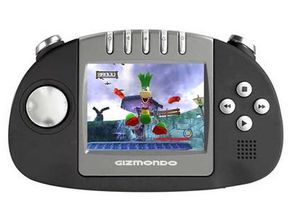
The Gizmondo has several features that make it more than just a gaming device. It includes a Windows MP3 playing center which "enables users to download and enjoy their music on the move, in digital quality through the stereo headset socket" [ref]. Without headphones, you have to rely on a small built-in mono speaker. Companies can also offer audio content via multi-media messaging service (MMS) streams. A scaled-down version of Windows Media Player lets users play movies in the MPEG 4 format, and they can send film clips and movie previews to other users with MMS.
In addition to playing music and movies, Gizmondo users can also take photos. The fixed-focal-length lens for the VGA camera function is in the back of the unit, so you can view the subject of your photo on the screen. Photos can then be shared among other Gizmondo users or with Bluetooth-enabled devices.
But how do Gizmondo users store and transfer MP3s, movies, pictures, and games onto the Gizmondo? The unit has a very small amount of internal memory, but it accepts Secure Digital (SD) cards. These cards are about the size of a postage stamp, and a one-gigabyte card will cost between $50 and $100. Two-gig cards are already available in Europe, and cards holding up to eight gigs of data are planned.
The built-in GPS is what really sets Gizmondo apart from other portable gaming devices. In addition to the basic navigation and map applications, parents can keep up with their children by tracking the Gizmondo and owners can set up a virtual fence around a geographic area (and get an automatic alert if the Gizmondo crosses the fence). Games that integrate the device's GPS position with game play are also generating a lot of excitement. We'll talk about those games in more detail in the next section.
Adding to the list of connectivity options is Gizmondo's Bluetooth support. This allows other Bluetooth-enabled devices to share data with Gizmondo, and two or more Gizmondo users can play multi-player games together.
Built-in copyright security features include digital handshake and the ominous sounding "destruct at engagement," which deletes certain kinds of unauthorized media files (it doesn't make your Gizmondo explode).
In the next section, we'll take a look at the games that are available for Gizmondo.