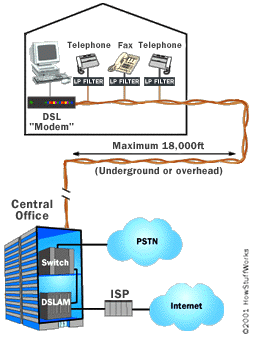
When you connect to the Internet, you might connect through a regular modem, through a local-area network connection in your office, through a cable modem or through a digital subscriber line (DSL) connection. DSL is a very high-speed connection that uses the same wires as a regular telephone line. Here are some advantages of DSL:
- You can leave your Internet connection open and still use the phone line for voice calls.
- The speed is much higher than a regular modem
- DSL doesn't necessarily require new wiring; it can use the phone line you already have.
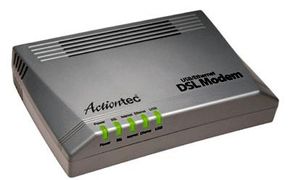
- The company that offers DSL will usually provide the modem as part of the installation.
But there are disadvantages:
Advertisement
- A DSL connection works better when you are closer to the provider's central office. The farther away you get from the central office, the weaker the signal becomes.
- The connection is faster for receiving data than it is for sending data over the Internet.
- The service is not available everywhere.
In this article, we explain how a DSL connection manages to squeeze more information through a standard phone line -- and lets you make regular telephone calls even when you're online.
Telephone Lines
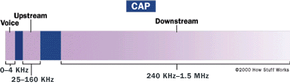
If you have read How Telephones Work, then you know that a standard telephone installation in the United States consists of a pair of copper wires that the phone company installs in your home. The copper wires have lots of room for carrying more than your phone conversations -- they are capable of handling a much greater bandwidth, or range of frequencies, than that demanded for voice. DSL exploits this "extra capacity" to carry information on the wire without disturbing the line's ability to carry conversations. The entire plan is based on matching particular frequencies to specific tasks.
To understand DSL, you first need to know a couple of things about a normal telephone line -- the kind that telephone professionals call POTS, for Plain Old Telephone Service. One of the ways that POTS makes the most of the telephone company's wires and equipment is by limiting the frequencies that the switches, telephones and other equipment will carry. Human voices, speaking in normal conversational tones, can be carried in a frequency range of 0 to 3,400 Hertz (cycles per second -- see How Telephones Work for a great demonstration of this). This range of frequencies is tiny. For example, compare this to the range of most stereo speakers, which cover from roughly 20 Hertz to 20,000 Hertz. And the wires themselves have the potential to handle frequencies up to several million Hertz in most cases.
The use of such a small portion of the wire's total bandwidth is historical -- remember that the telephone system has been in place, using a pair of copper wires to each home, for about a century. By limiting the frequencies carried over the lines, the telephone system can pack lots of wires into a very small space without worrying about interference between lines. Modern equipment that sends digital rather than analog data can safely use much more of the telephone line's capacity. DSL does just that.
A DSL internet connection is one of many effective communication tools for keeping employees in touch with the office.
Advertisement